Home
-Archives 2 - Archives
3
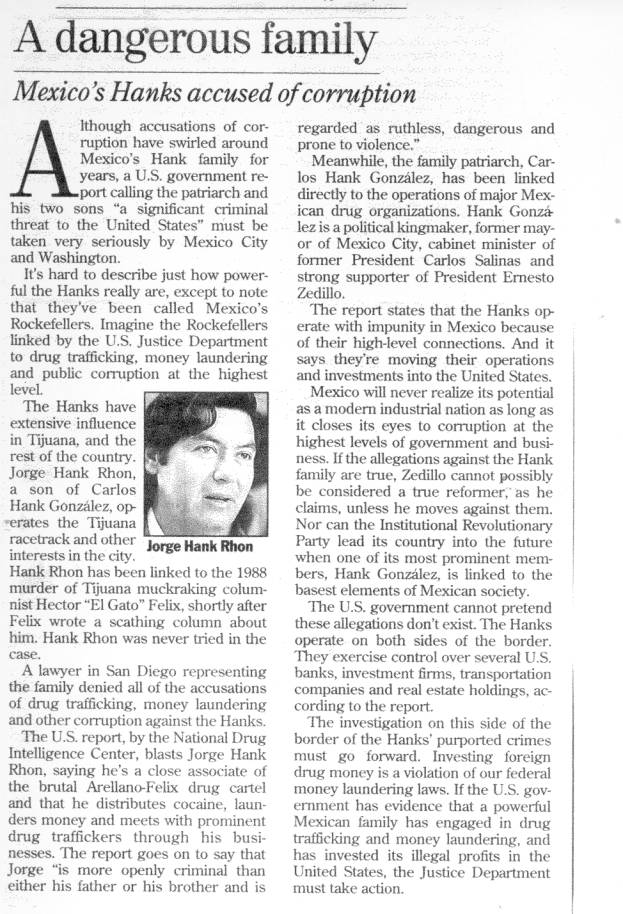
Corruption on the Border
Archive Page One
Subject: Airport Security:
I have been in law enforcement for about 25 years until recently when I
left U.S. Customs in 1998. I also have a martial arts background of 33 years. I
was also in the United States Secret Service and was stationed in Washington,D.C.
protecting Presidents and their families at The White House as well as
protecting embassies and dignitaries.
I am considered an expert at screening people, luggage, vehicles, commercial trucks,
containers, commercial and private airplanes, ships and small
boats, military, dignitaries, etc....I was also cross trained as an INS official and
can process foreigners with passports.
I can say with confidence that there is not enough "proper" security
or
security personnel who are trained well enough to conduct proper screening
of persons who are boarding aircraft as well as their luggage.
I for one have been very critical of the way our government operates at the
nation's borders with regards to U.S.Customs and U.S. Immigration screening
procedures for at least 7 years.
I am also in touch with other "former" and "current" law
enforcement
personnel who confide in me on a daily basis about the horrible conditions
in which our government is allowed to operate.
One former Vietnam Vet and law
enforcement official who recently traveled
out of Lindbergh Field told me that a national guardsmen checked his
luggage by merely pushing on the luggage. Unless this young man was clairvoyant
or had X-Ray eyes, he did not do his job correctly. The luggage should have
been visually inspected after opening the luggage.
On another occasion another former law enforcement officer traveled from
Chicago and was NOT checked properly when the "metal wand" was used
for
detecting metal objects after setting off the "walk through" device.
The
female guard was challenged by the former law enforcement official and
asked why she did not check further if there was a possible metal object in
the
crotch area and the female guard stated, "Oh, we're not allowed to touch
people there. It's an invasion of privacy laws". This women security guard
was over the age of 50.
Let me explain further that hiring national guard personnel is not a good
thing unless they have been properly trained and know how to deal with the
public. I have worked with national guard units at the border since 1989
and a very small percentage last very long. Only national guard units with
assignments as M.P.'s or Military Police or who have a law enforcement
background should be allowed to conduct special security at check points.
I have seen other occasions where national guard are very helpful, but did
not really have the proper training and experience to be allowed to have
contact with the general public.
Now we are having these weekend warriors thrown at us with fully automatic
rifles. Not all of these national guardsmen are fully trained with law
enforcement backgrounds and some are females over the age of 40. I just
hope they can retain their weapons if they are challenged? If I was a
terrorist,
I wouldn't need to bring any weapons if I can take one away from an older
female or male guardsman with little difficulty. Weapons retention is one of
the more serious things you learn in law enforcement academies and martial
arts.
I have also been told that people weren't being checked properly at an airport
in Massachusetts and Vermont recently as well.
It is time we put people in charge of security at the airports who have a
specialized background and training. We can not rely on minimum wage
security guards who have no real expertise. I think we should
"Federalize"
all International Airports and deputize the security U.S. Marshal's.
I can also tell you about specific security problems at Lindbergh Field
with regards to my apprehending at least a "dozen" baggage
handler employees who
were caught violating the Federal Inspection areas while a "foreign"
commercial aircraft was being processed. They tried to enter the restricted
areas without a proper Customs security seal. (This is how they smuggle at
the airports as well as intercept undeclared merchandise on the plane that
never arrives in the Customs inspection areas)
I was not well liked by Customs management for doing my job.
I have recently communicated my
concerns to the White House and the Office
of Homeland Security without any real responses as of yet.
John Carman-Former U.S. Customs
Editor of www.customscorruption.com
Airport
Security Too Lax
Travelers
Complain
http://www.uniontrib.com/news/uniontrib/mon/news/news_1n5secure.html
By Jeff McDonald
STAFF WRITER
November 5, 2001
While federal lawmakers continue to argue over how best to safeguard airports
across the United States, passengers flying into and out of Lindbergh Field
since Sept. 11 are finding huge lapses in security.
According to an informal survey of airline
passengers conducted by The Union-Tribune, striking inconsistencies exist
between the way identification, tickets and luggage are checked in San Diego and
elsewhere.
Air terminals in many American cities have yet to
implement uniform standards for even the most cursory safety inspections.
Travelers may be passed through checkpoints in 10
minutes at one airport and delayed for hours at another. Pocket knives or other
potential weapons are confiscated before some flights but are missed altogether
before others.
Airline workers told to compare photo IDs with
boarding passes often fail to make eye contact with ticket holders. Empty cars
sometimes idle unchecked in front of passenger loading zones.
One flier said a guard at an airport metal
detector could not speak enough English to ask a passenger to remove a laptop
computer from its carrying case.
"If there is increased security at U.S.
airports, the FAA is keeping it well hidden," said Shiela Rabell, an
apartment manager from Alpine who traveled to Puerto Vallarta, Mexico, last
month through San Diego and Phoenix.
Last week, The Union-Tribune asked readers to
submit their recent travel experiences in letter form to an e-mail account set
up by the paper. Sixty-eight people responded with stories of lax oversight,
inattentive guards or airline employees and potential gaps in safety protocols.
In interviews and in the letters, many expressed
worry that most checked luggage is not X-rayed or that suitcases are not
routinely checked for matching to passengers once their flights arrive and they
prepare to leave the airport.
Ed and Karyl Brabants of Tierrasanta traveled to
Providence, R.I., two weeks after the terrorist attacks. They anticipated heavy
security along the way, but were unpleasantly surprised.
"It was business as usual," said Ed
Brabants, a retired postal worker. "We were stunned that there appeared to
be no tightening of security at all."
During a journey last month to Central America,
Tim and Amy Concannon twice made it through airports in Dallas and San Diego
with a 2-inch Swiss Army knife dangling from a key chain.
"The knife was brought to our attention by
the Costa Rican security," said Amy Concannon, an Escondido veterinarian
who was surprised when inspectors returned the knife to her husband. "It
was then missed again by American security on our return flight from Dallas to
San Diego."
The hijackers accused in the Sept. 11 attacks are
suspected of using box cutters to overwhelm flight crews and crash planes into
the World Trade Center and the Pentagon.
Jane Dale wrote that when she traveled from San
Diego to Alaska on Sept. 21, security crews confiscated a quarter-inch nail
clipper but failed to inspect the contents of a lead bag designed to protect
film from X-rays.
"It would seem that if they can't see it, it
can't be dangerous," she said. "I could have carried a weapon on board
undetected."
Not a secret
John Carman of La Mesa, a former U.S. Customs
Service inspector who now works as a private investigator, said law enforcement
officials around the country have known for years that airport security is
grossly inconsistent.
"It is time we put people in charge of
security at the airports who have a specialized background and training,"
he said. "We cannot rely on minimum-wage security guards who have no real
expertise."
Most other responses to the survey recounted
stories of guards who failed to inspect identification or paperwork, metal
objects slipping through detectors or agents who did not require proof from
people claiming to be airline or airport employees.
Not all respondents were skeptical of the
tightened security that has been publicized by government officials, however. A
handful of fliers, like Dianne Lohner of Mira Mesa, praised the strict new
enforcement policies.
"We were glad to see the extra security
processes in place and definitely felt safe about flying," said Lohner, who
returned Oct. 29 from a 10-day trip to Portland, Ore.
Federal legislation intended to plug holes in
airport and airline security stalled last week in Congress, where dueling bills
failed to muster majority support from both houses.
At issue is whether baggage checkers should
become federal employees, a prospect most Republicans oppose. Democrats say
private-security policies now in place do not adequately protect passengers.
Hiring is an issue
The question is critical because security companies
are profit-driven firms that have been criticized for recruiting high-turnover,
minimum-wage employees with little or no experience.
Argenbright Security, for example, the nation's
largest airport security firm, was accused by the Justice Department of hiring
screeners with criminal records at Los Angeles International and other airports.
In San Diego, one of the companies that inspects
Lindbergh Field filed for bankruptcy protection days after the terrorist attacks
on New York City and the Pentagon, although the company said the filing was not
linked to the attacks. Officials say local passengers remain safe.
Resolving the impasse on whether to turn airport
security crews into federal workers is likely to take negotiators from the House
and Senate weeks.
In the meantime, Jerry Snyder of the Federal
Aviation Administration office in Los Angeles maintains that consistent
standards for airline security at the nation's airports make air travel safe.
Yet, he added, "how those standards are
achieved is given latitude for the various air carriers and their security
forces."
Government investigators years ago identified
major security breaches at American airports. In reports issued in 1993 and
1999, the inspector general of the U.S. Department of Transportation recommended
sweeping reforms.
"Airport access control has been, and
continues to be, an area of great concern," the 1999 report states.
According to inspectors, that analysis was all
but ignored.
Divided roles
Responsibility for security within airports is
divided between airlines and airport managers. In general, airport managers make
sure the terminals and exteriors are safe, while the airlines protect passengers
at gates and on planes.
Even though federal regulations spell out
specific responsibilities for airlines and airport managers, the extent of
inspections can vary greatly from gate to gate and airport to airport.
"Everyone is doing a good job, but is it
consistent? No," said Rita Vandergaw, spokeswoman for the San Diego Unified
Port District, which oversees Lindbergh Field. "This is a challenge for us,
as it is at many airports."
Rather than dividing responsibility for passenger
safety inside the terminals between airports and carriers, Vandergaw said the
port district would prefer that airports be given complete authority over
security.
"If airports had the responsibility for
which they're held accountable, anyway, you would get a more consistent
(enforcement) standard," she said.
| October 18, 2001
OPM to
investigate suspicious appointments at Customs
By Tanya N. Ballard
tballard@govexec.com
The Office of Personnel Management plans to review
the circumstances surrounding several political appointments made at the
Customs Service over the last two years, according to a new General
Accounting Office report.
In 1998, the Treasury Department asked the Office
of Personnel Management for the authority to add 10 law enforcement
positions at Customs under the Schedule A excepted hiring authority,
without regard to competitive civil service rules. In asking for the
additional hiring authority, Treasury officials told OPM that because of
the ãsensitive natureä of the needed positions, publicly advertising
them was not desirable. OPM approved the positions and Customs went on
to fill nine of the positions between September 1998 and January 2001.
But in a new report, ãPersonnel
Practices: Circumstances Surrounding U.S. Customs Serviceâs Use of
Schedule A Appointment Authority,ä GAO said five of those
appointments raised eyebrows.
Many politically appointed federal employees
attempt to convert their work status from political appointee to career
civil servant shortly before a presidential election in an attempt to
remain in the executive branch÷a practice known as ãburrowing in.ä
Two of the Customs appointments, for a law
enforcement specialist and a public affairs specialist, were
inconsistent with Treasuryâs assertion that the needed positions were
ãsensitive in nature,ä GAO found. Later, Customs created identical
positions, advertised them and then hired the two appointees to fill
them.
Customs claimed they decided after appointing the
two employees that the positions were needed permanently at the agency.
Circumstances suggested that the two appointees might have had an unfair
competitive advantage in getting the jobs, GAO said. Still, GAO could
not determine that the two appointees would not have been hired based on
their education and work experience prior to joining Customs.
Two other appointments raised a red flag among
Treasury officials. Just before the Bush administration, two noncareer
Senior Executive Service employees were appointed--one as a law
enforcement appropriations officer and one as a strategic trade advisor.
Although OPM determined that both of the appointments were made with the
legitimate use of Schedule A authority, the agency, in its written
response to GAOâs report, said it was concerned about the appearance
of political favoritism surrounding these cases.
OPM is now planning its own review of all the
appointments, as well as a review of the original justification for
allowing the additional appointments.
|
| HAVE YOU
SEEN THESE MEN?
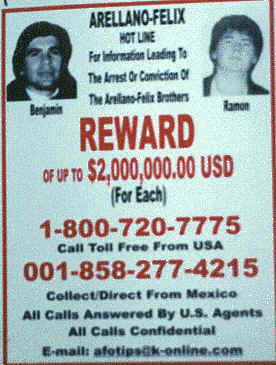
If you have...email: afotips@k-online.com
or
call the numbers on this poster |
Mexico Police Probe
Mystery Corpse
By Isaac Guzman
Associated Press Writer
Saturday, February 23, 2002; 7:00 AM
MAZATLAN, MEXICO öö The first parade of Carnaval
was still hours away, but local families were already setting up
folding chairs along Mazatlan's beachfront boulevard to be sure of a
clear view.
In the tourist-heavy Zona Dorada, state police agents called in to
give extra security for the local version of Mardi Gras said they saw
guns through the windows of a Volkswagen Bug cruising past bars,
hotels and souvenir shops. They began to follow the vehicle around
10:30 a.m.
The resulting chase on Feb. 10 left three men dead on the
sidewalks. Nearly two weeks later, Mexican and U.S. officials
are trying to figure out if one of them was Ramon Arellano Felix,
allegedly one of the world's most violent drug traffickers and a
fixture on the FBI's 10 Most Wanted list.
"We are investigating, looking for evidence," Mexican
Attorney General Rafael Macedo de la Concha said Friday as he
accompanied President Vicente Fox on a tour of the Guatemalan border
region.
He said his agency is "exchanging information" with U.S.
officials.
"We have to exhaust all the tools that exist so that we can
establish whether this hypothesis is a reality," he said.
In Washington, DEA spokesman Michael Chapman said Friday that U.S.
officials were investigating reports of the killing.
The death of Arellano Felix would be a major blow to the
Tijuana-based cartel allegedly run by he and his brothers,
officials say. Ramon Arellano Felix is the security
chief for a group accused of killing about 300 police, prosecutors,
judges, rivals and a Roman Catholic cardinal over the past 15 years
while shipping tons of cocaine, marijuana, heroin and amphetamines
across the border.
According to police accounts, the men in the Volkswagen drove into
a parking garage near the Plaza Gaviota Hotel and fled on foot ö one
briefly seeking shelter in the room of two Mexican college students
who had come to play in a Carnaval band.
Finally the suspects emerged and began exchanging shots with the
police. One of the policemen and two of the suspects were killed. Two
others were captured and another man ö who turned out to be a
federal police officer ö was also arrested. All three have denied
involvement.
The bodies of the two suspects were sent to a local funeral home. A
day later they were gone, turned over to people claiming to be
relatives, according to workers at the funeral home who nervously
refused to give further details and asked that even the name of their
company be withheld for their safety.
Federal police identity cards, found on both of the dead suspects,
turned out to be false, state prosecutors said.
Sinaloa state Deputy Attorney General Felipe Renault told a news
conference Friday that one of the men was identified as Efrain
Quintero Carrizoza, who was wanted for involvement in the Feb. 14,
2001, massacre of 12 people in Limoncito, a village not far from the
state capital of Culiacan. That killing was believed to be drug
related.
The other man's card identified him as Jorge Perez Lopez. It
carried the photo of a crop-haired man whose features otherwise looked
remarkably like those of the shaggy-haired image of Arellano Felix
that appears in FBI wanted posters alongside that of Osama bin Laden.
The U.S. government has offered $2 million for Arellano Felix's
capture.
Funeral home workers told reporters only that state prosecutors had
ordered them to release the bodies. State officials have refused to
comment on the case, saying the matter is now being investigated by
Macedo's federal Justice Department.
Macedo said officials were "establishing what happened to the
body" of the man they say could be Arellano Felix.
"It's not in our possession," he said.
Mexican police have arrested several alleged key operatives of the
gang in recent years, but have failed to reach the Arellano Felix
brothers, who are accused of offering millions of dollars in bribes to
officials, and of butchering those who refuse them.
Mexican prosecutors say the gang's victims include the late Roman
Catholic Cardinal Juan Jesus Posadas Ocampo, who was shot to death in
a fusillade of bullets at the Guadalajara airport in 1993. They say
the Arellano Felix gang confused the cardinal's car with that of their
target, rival drug gang leader Joaquin Guzman Loera.
STORY CONTUNUED
|
Drug
kingpin may have been shootout victim
|
 |

By Anna Cearley and Marisa Taylor
UNION-TRIBUNE STAFF WRITERS
February 23, 2002
Mexican and U.S. officials are investigating whether a leader of
Mexico's most powerful drug cartel died in a shootout with police
this month.
The death of Ram—n Arellano FŽlix, who is on
the FBI's 10 Most Wanted list, would strike at the core of the
Tijuana-based drug cartel, which is said to control the passage of
huge quantities of drugs into the United States.
Ram—n Arellano is believed to be the cartel's enforcer,
orchestrating the killings of rivals and law-enforcement
officials, while his brother, Benjam’n, is said to be the
cartel's businessman.
Mexican officials don't deny the possibility that the dead man
who was first identified as Jorge PŽrez L—pez may be Ram—n, 37.
But they no longer have the body to prove it.
The man believed to be Ram—n Arellano and a man in his
company, identified as Efra’n Quintero Carrizoza, were killed
Feb. 10 in a shootout with state police in the Sinaloan resort
city of Mazatlan. A day later, people who said they were family
members claimed the bodies in what some suspect was an attempt to
prevent authorities from identifying Ram—n Arellano.
Mexican authorities say they have evidence ö including
fingerprints ö that is being used to determine the man's
identity. They are working closely with U.S. authorities.
"We are looking to confirm the facts through scientific
and investigative methods," said Rafael Macedo de la Concha,
Mexico's attorney general.
The U.S. Drug Enforcement Administration, which has a small
office in Mexico City, is assisting with the investigation. DEA
agents aren't allowed to carry weapons in Mexico, so they usually
are limited to gathering evidence and intelligence and passing it
along to Mexican law-enforcement agencies.
Thomas Lenox, a DEA spokesman in San Diego, said a confirmation
of the reputed kingpin's death could help law-enforcement agencies
on both sides of the border.
"It could cause some disruption within the organization
and hopefully give us some leads that might help us completely
dismantle the organization," Lenox said.
Mexican media in Sinaloa and Baja California have quoted
unnamed sources saying that Ram—n Arellano came to Mazatlan to
kill his longtime rival, Ismael "Mayo" Zambada Garc’a,
after learning that Zambada was going to attend the city's
Carnaval festivities. Zambada was rumored to be moving into
the Arellanos' territory in 2000, when Tijuana's police chief,
Alfredo de la Torre M‡rquez, was killed in a hail of bullets.
Yesterday Tijuana's Zeta weekly
newspaper published a photo of Ram—n Arellano next to a photo of
a federal police identification card, which is said to be false,
found on the body of PŽrez L—pez. In the article, editor
Jesœs Blancornelas said his sources are 95 percent sure the man
is Ram—n Arellano.
"But the 5 percent could change everything," said
Blancornelas, who doesn't discount the possibility that the
brothers have undergone plastic surgery. Blancornelas almost died
in a 1997 ambush that is widely believed to have been ordered by
Ram—n Arellano.
If Ram—n Arellano is dead, some believe the damage to the
cartel would be minimal.
"They have the capacity to reorganize, to reproduce and
regain their strength," said V’ctor Clark, a human-rights
activist who follows the border underworld closely. "This is
an eternal battle."
Peter Nu–ez, former U.S. attorney in San Diego, said other
drug traffickers might scramble for power within the cartel.
"The only question is whether the remainder of the group
is strong enough to resist an attempt by a rival to take over the
cartel," he said.
The shootout took place at 10:30 a.m. on a Sunday during
Mazatlan's weekend Carnaval celebration.
The man believed to be Arellano was in a white Volkswagen with
at least one other man, authorities in Sinaloa said yesterday.
State police, who had tightened security for Carnaval, waved them
over for an inspection. The men took off with the police in
pursuit.
The pursuit ended in gunfire in front of Las Gaviotas hotel,
leaving one state agent and two of the suspects dead. Federal
police credentials found around their necks, now said to be false,
identified the suspects as Jorge PŽrez L—pez and Hector Sol—rzano
JimŽnez.
Media reports said the people who took the bodies the next day
used false documents and claimed to be family members of PerŽz
and Sol—rzano. The family members weren't interviewed by
officials at the morgue, raising questions about whether they were
given special treatment. But yesterday the State Attorney
General's Office in Sinaloa said proper procedures had been
followed.
Mario Mill‡n, a spokesman for the Attorney General's
Office, said state investigators had turned over evidence,
including fingerprints from the corpses, to the Federal Attorney
General's Office.
Yesterday, the state office announced it had identified the
body of Sol—rzano as Efra’n Quintero Carrizoza, who was wanted
in Sinaloa in connection with the massacre of 12 people on
Valentine's Day of 2001.
State investigators identified Quintero through their
fingerprint database, which doesn't include the Arellano brothers'
prints, Mill‡n said. He expected that federal officials, who in
Mexico investigate drug-related crimes, would try to match the
corpse's prints with Arellano's.
Three men were detained in the shooting's aftermath. Manuel L—pez
L—pez and Manuel Asunci—n Hern‡ndez were found at or near the
hotel, Mill‡n said. Authorities also arrested a federal police
officer, Sergio Reyes Cruz, who arrived at the hotel later.
The Arellano brothers have managed to evade arrest for more
than a decade, even though the FBI placed Ram—n on its 10 Most
Wanted List in 1997 and is offering $2 million each for their
arrest or conviction.
They are accused in a San Diego federal indictment of
bribing unidentified public officials, money laundering and
smuggling cocaine and marijuana. They also allegedly ordered a
string of killings and kidnappings and are accused of recruiting
San Diego gang members who mistakenly killed a Mexican Roman
Catholic cardinal during a 1993 attempt to assassinate a cartel
rival.
If arrested and convicted in the United States, the brothers
face up to life in prison and fines of $27 million.
Rumors about the Arellanos' whereabouts come in cycles and
often turn out to be false, said Francisco D’az de Leo'n, deputy
consul general of the Mexican consulate in San Diego.
"That's one of the reasons why the Mexican and U.S.
governments have to be very careful about unconfirmed
reports," he said.
But any confirmation of the reports would be another sign of
cooperation in the two countries' efforts to dismantle the cartel,
D’az de Le—n said.
"We expect them to try to continue to resist with violent
acts, but we are going to continue to fight them," D’az de
Le—n said. "In no way will we let down our guard."
Anna Cearley: (619) 542-4595; anna.cearley@uniontrib.com
|
 |


DOB: 03/12/52
(Alt 11/08/53)
(Alt 08/11/55)
Benjamin Arellano-Felix assumed leadership of the
Arellano-Felix organization after Miguel Angel Felix Gallardo
was arrested in 1989 for his involvement of the murder
of DEA Special Agent Enrique "Kiki" Camarena.
Benjamin manages and oversees all of the cartel's drug
trafficking operations.
Benjamin was arrested on June 18, 1982 in Downey, California
for receiving 100 kilos of cocaine smuggled through the San
Ysidro border. He is currently a fugitive based on a federal
indictment issued in San Diego on May 2, 1989 for conspiracy,
money laundering, controlled substance trafficking, aiding and
abetting and operating a criminal organization.
On May 11, 2000 U.S. authorities unsealed a 10-count
indictment charging Benjamin Arellano-Felix and his brother
Ramon with operating a drug smuggling organization and
kidnapping and murdering rival drug traffickers, informants and
law enforcement officers. Benjamin Arellano-Felix has also been
included in the $2 million reward offered for information
leading to the arrest of his brother Ramon, who has been on the
FBI's most wanted list for three years.

DOB: 08/31/64
(Alt 11/29/46)
(Alt 07/29/45)
 Ramon Arellano-Felix, considered the most violent brother,
reportedly coordinates the organization's security, often
recruiting personnel from violent street gangs. The AFO's
security forces, described by Mexican law enforcement officials
as paramilitary, are well-trained and well-armed. One of Ramon's
responsibilities is to plan the murders of rival drug leaders,
those law enforcement officials not on the take, and any members
of the AFO who fall out of favor with the cartel leadership.
Ramon Arellano-Felix, considered the most violent brother,
reportedly coordinates the organization's security, often
recruiting personnel from violent street gangs. The AFO's
security forces, described by Mexican law enforcement officials
as paramilitary, are well-trained and well-armed. One of Ramon's
responsibilities is to plan the murders of rival drug leaders,
those law enforcement officials not on the take, and any members
of the AFO who fall out of favor with the cartel leadership.
Ramon was issued an arrest warrant on June 16, 1993 for drug
and arms violations. In September 1997, his picture was added to
the FBI's 10 Most Wanted list. He had been secretly indicted by
a San Diego grand jury for money-laundering and drug
trafficking. Ramon and his brother Benjamin were indicted on May
11, 2000 for operating a drug smuggling operation and
maintaining it through violence, threats and bribery. The two
were also designated appropriate for sanctions on June 2, 2000
through the Kingpin Act, which targets the activities of
significant foreign narcotics traffickers and their
organizations on a worldwide basis.
The U.S. State Department has offered a $2 million reward for
information leading to Ramon Arellano-Felix's capture.

DOB: 11/12/69
Reportedly the third-ranking member of the cartel after
brothers Benjamin and Ramon, Francisco Javier controls the
organization's finances. In 1997, An arrest warrant was issued
for him in Guadalajara, Jalisco, Mexico, on drug and arms
violations. He was also included along with his brothers
Benjamin and Ramon in the $1 million reward offered by Mexican
federal prosecutors for their capture.

DOB: 10/24/49
The eldest Arellano-Felix brother, Francisco Rafael
Arellano-Felix, coordinated the buying and selling of narcotics
for the organization. On December 4, 1993, he was arrested by
the Mexican Federal Judicial Police in Tijuana, who seized
$150,000.00 from him. As of October, 2000, he is the only
Arellano-Felix brother currently behind bars, Francisco is
incarcerated at the Almoloya De Juarez Maximum Security Prison
in Toluca, Mexico, on violations of illegal arms possession,
drug charges, and complicity in the murder of Cardinal Posadas
Ocampo. Francisco Rafael Arellano-Felix continues to serve his
seven-year sentence, but with time off for good behavior, he
could be released at any time.

DOB: 11/10/56
Eduardo Arellano-Felix reportedly coordinates the smuggling
of cocaine shipments to the United States. In 1982, he was
arrested along with his brother Benjamin and wife Maria
Esperanza Martinez de Arellano in Downey, California. They had
received 100 kilograms of cocaine smuggled through the San
Ysidro, California Point of Entry. In 1993, the Southern
District Court of California issued a warrant for his arrest for
weapons offenses.

DOB: 08/20/55
Carlos Arellano-Felix's role in the Tijuana Cartel is to
reportedly coordinate the smuggling of narcotics into the U.S.
He currently is not wanted in the United States.

DOB: 01/26/66
Luis Fernando Arellano-Felix allegedly runs the family-owned
businesses, which are reportedly used for laundering the drug
proceeds for the Arellano-Felix Organization. He currently is
not wanted in the United States.

DOB: 03/17/61
The arrest of Ismael "El Mayel" Higuera Guerrero in
May 2000 dealt a severe blow to the Arellano-Felix Organization.
Reportedly a principal lieutenant for the AFO, Higuera Guerrero
ran cross-border drug trafficking operations and directed the
kidnapping, murder and torture of cartel rivals. He has been
described as one of the main contacts between lower level drug
smugglers and the Tijuana Cartel.
On May 4, 2000, Mexican soldiers and federal police arrested
Higuera Guerrero and eight others after a raid on his beachfront
home in Ensenada. Following his arrest, federal prosecutors in
San Diego unsealed an indictment against Higuera, accusing him
of drug trafficking and money laundering. The federal charges
filed against him stem from the capture in 1995 of an airplane
carrying 10 tons of cocaine. Higuera Guerrero also faces a
homicide charge in a Baja California state court for his role in
the 1994 slaying of Tijuana's federal police commander, Federico
Ben’tez L—pez. He has also been linked to the slayings of the
three anti-drug agents in Tijuana last April, as well as the
murder of Tijuana's police chief, Alfredo De la Torre M‡rquez
last February.
Higuera Guerrero had formed a group of collaborators
including his son Ismael Higuera Flores, who was arrested by the
PGR in May of 1998 for possession of weapons and drugs and
subsequently freed on bail. His other son, Gilberto Higuera çvila,
reportedly controls the cartel's drug trafficking operations out
of Mexicali.
Mexican prosecutors filed new charges of drug trafficking and
organized crime against Higuera Guerrero in May. He is now being
held at the maximum-security prison Almoloya de Ju‡rez prison
in Mexico City.


On March 12, 2000, Mexican soldiers armed with automatic
weapons nabbed Jesœs "El Chuy" Labra AvilŽs, the
AFO's financial mastermind, as he watched his son play football
in Tijuana. Authorities on both sides of the border consider his
arrest a further step toward dismantling the Arellano-Felix
Organization. Accused of illegal possession of a firearm, Labra
AvilŽs was flown to Mexico City, where a judge placed him under
house arrest for three months. In May of 2000, Mexican
prosecutors filed new charges against both Higuera Guerrero and
Labra AvilŽs, accusing them of drug trafficking and organized
crime. Labra was subsequently transferred to the maximum
security prison Almoloya de Juarez.
Days after Labra's arrest, his lawyer, Gustavo Galvez Reyes,
was found tortured and killed.

Manuel Aguirre Galindo, part of the Arellano-Felix
Organization's "consejo de jefes" or "chief
counsel" of high-ranking members, is allegedly responsible
for establishing relationships with businesses in which the
cartel invests its earnings.
|
|
http://www.worldnetdaily.com/news/article.asp?ARTICLE_ID=25019
Tracking Terrorism
© 2001 WorldNetDaily.com
Last week I
wrote about how vulnerable virtually every American citizen is to
terrorism due to vast corruption in the U.S. Customs Service, whose
job is to protect us from abuse of the expansive network of railways
snaking across our great land.
In recent years, this life-giving national arterial
system has gradually been poisoned by drug cartels and terrorist networks
who use the myriad railroad veins and spurs to transport their addictive
and destructive goods. This threat first came to my attention by former
Customs Agent-turned-whistleblower Darlene Catalan's chilling
first-hand account of government efforts to silence her when she began to
expose corruption within the department.
Since last week I have been deluged with new
information from train engineers, railway workers and brave government
"whistleblowers" who have long known about this internal threat
to national security.
It seems many "in the know" have been
concerned for quite some time about how vulnerable the system is to
terrorist attacks.
First, please understand what they report:
- Five-to-10,000 unsearched railroad tanker cars
enter our country every single day from Mexico, Central and South
America;
- the Guadalajara rail yard is controlled by the
Arellano-Felix cartel;
- Osama bin Laden has long depended on his massive
crops of opium in Afghanistan to fund his terrorist operations;
- his and other terrorists' "crops" are
routinely shipped to South and Central America where they are loaded
onto trains headed for the U.S.;
- terrorist networks have intimate knowledge of the
system and how to use it;
- our Customs Service is fraught with corruption and
for years has allowed these massive shipments of drugs to enter the
U.S.;
- illegal aliens are entering our country every day
from countries long known to sponsor terrorism.
So here are the logical questions: Just when are bin
Laden et al. going to use the railway system to transport biological,
chemical or other warfare into the heartland of America? Are tanker cars
already stationed throughout the U.S. just waiting to be exploded? Are
"sleeper" terrorists lurking around our nation's train yards
awaiting the word to attack?
As Catalan explained to me last week, the routing of
the tanker cars is directed via remote control. The leaser of the tankers
need only to place their orders via the Internet or telephone. There is no
system in place to verify the identity of those directing the shipments.
And, as I have learned through additional information and research, there
is every likelihood that whatever "on the ground" terrorist
support is needed to achieve massive destruction through tanker cars could
easily already be in place.
This "clear and present danger" to American
security must be addressed now.
Gary Aldrich, a former 26-year veteran of the FBI,
agrees: "As former agent Catalan has exposed, there is tremendous
corruption along our borders which has allowed our country to be
infiltrated by those who wish us harm. Honest agents on the ground are
routinely thwarted in their attempts to protect our nation, leaving us and
our railways extremely vulnerable to terrorist attacks."
Aldrich should know, he's made it his mission to
expose corruption in high places through supporting brave, credible
"whistleblowers" from within government agencies. Aldrich is
founder of the Patrick Henry
Center, which seeks, in part, to "assist in the uncovering of
serious wrongdoing in the federal government, will promote and protect
every citizen's right to know, to speak out, and to correct corruptions no
matter where they occur."
It is crucial to understand just how porous our
borders are to illegal aliens gaining access to our country by the
thousands each week.
We traditionally think of these illegal aliens as
poor Mexicans attempting to gain access to a better life in America. But
increasingly, the illegal aliens crossing into our country from both
Canada and Mexico are identified by agents as "OTMs" ö border
lingo for "other than Mexicans." An estimated one in 10 illegal
aliens "caught" are from countries like Egypt, Iran or Yemen.
How many get by undetected? Several of the scum
involved in the brutal attacks of Sept. 11 entered the nation through
Canada. Experts believe that there are many more currently among us who
gained entry the same way, and many more attempting to enter even as you
read this column.
Former Secret Service agent, law enforcement official
and U.S. Customs agent John Carman worked the Southwest
Border for 15 years and still monitors the activity through official
contacts and civilian sources. He recently told me, "At the present
time, corruption along the borders is so bad and morale among the agents
so low that it doesn't shock me in the least that Middle Eastern
terrorists are making their way into our country undetected. I have
gathered information that indicates certain INS officials have, just in
the last year, been allowing the illegal entry of Middle Eastern nationals
through the world's largest land border port at San Ysidro. Some of this
information was stated to me by Iraqi nationals living in San Diego, who
are relatives of other Iraqis waiting to be allowed entry into our country
through political asylum or visas."
The methods America uses to issue visas has long
allowed individuals from countries that sponsor terrorism easy access to
our communities. Some 3,700 U.S. consular offices around the world issue
millions of visas every year. Eighty percent of the 8 million visa
applications are approved by our State Department annually.
As Phyllis Schlafly, a long-time advocate of halting
the flow of illegal aliens into the country recently
exposed, "The State Department manual used by consular officials
states that 'mere membership' in a recognized terrorist group, or even
'advocacy of terrorism,' does not automatically disqualify a person from
entering the United States."
Indeed, On Oct. 16 WorldNetDaily's Washington Bureau
Chief Paul Sperry broke
the disturbing news that 14 Syrian pilots gained access to the U.S. on
Oct. 14 and 15 through visas allowing them to attend flight school in Fort
Worth, Texas. Syria, as anyone who has been following world events of late
knows, is one of the key nations known to harbor and support terrorists.
This single act is a disgrace to American security.
The fact that it happened within a few weeks of thousands of innocent
civilians losing their lives to terrorist thugs on our own soil, some even
in the Pentagon, is unconscionable.
It's time to demand answers and immediate responses
by our government. The terrorists know of our vulnerability, and now you
do too. Please do your part in alerting your elected officials.
|
|
An Actual Email Correspondence
From: "John Carman" <jcarman@cts.com>
To: "George W. Bush" <President@whitehouse.gov> Sent:
Saturday, October 13, 2001 11:30 AM Subject: Fw: The Postal Connection
Continued
****************************************************************************
***************************************** Dear Sir: If they can smuggle
small amounts of Heroin, they can mail contaminated Anthrax as well. I
hope you can use this information as I get it. It comes from people I
trust who are still in Customs and Management isn't listening. God Bless!
John Carman Editor- www.customscorruption.com
****************************************************************************
****************************************** ----- Original Message -----
From: Deleted For safety Reasons To: <jcarman@cts.com> Sent:
Saturday, October 13, 2001 9:30 AM Subject: Re: The Postal Connection If
you know the USPS they are getting all of the press that they need with
the anthrax scare. What they don't say is that they prevent us from doing
two legal things that would greatly facilitate the stopping of terrorist
activities and money laundering.
1) They are the only carrier that
actively prevents that Customs Service from "re-examining
"freight that has initially cleared and is still in their possession.
Imagine having a dog alert on a parcel at an airfreight facility that has
been cleared on a "general" exam through selectivity processing
and having the airline say, with the force of federal law enforcement
officers, that we could not open the package. Well the Postal Service says
that even though the parcel is still in their possession and no matter
what the reason (dog alert, ticking bomb, parcel going to a known drug
house, or just because it looks like it should be examined again [or for
that matter for the first time] ) that even though the Customs Regulations
and court decisions to the contrary and the fact that the imported parcel
has not been legally "permitted" because it is still in the
possession of the importing carrier, the Customs Service needs a Federal
Search warrant to open the parcel.
2) The Postal Service still has not
capitulated to the changes in laws regarding export examinations by
Customs that were passed several years ago. The plain language of the law
says that the merchandise is subject to examination by Customs when it is
taken possession by the exporting carrier with "intent to
export". If someone addresses a parcel to a foreign country, puts
some stamps on it and puts in the hands of the Postal Service then aren't
they intending to export the parcel and isn't the exporting carrier the
Postal Service? The dopers and others love Express Mail. Check out the
amounts of Express Mail going to Colombia and coming from Colombia. The
dopers know that the Postal Service prevents us from examining export mail
but not import mail. IF we are going to get involved with this new agency
shouldn't we also be "law enforcement " as the agents and
marshals are? When we were detailed to be domestic security at O'Hare
after 9/11 we were sworn in as Special Deputy Marshals. We are armed, with
vests, with the authority but not with the retirement or pay. What is
wrong with this picture?
From: Deleted |
Special Feature: Drug Warriors
What's New?
|
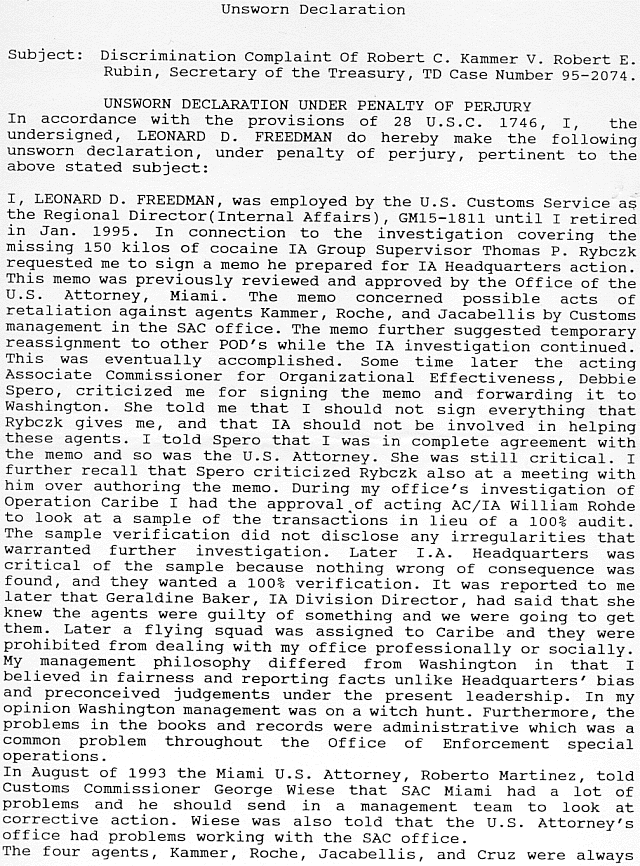
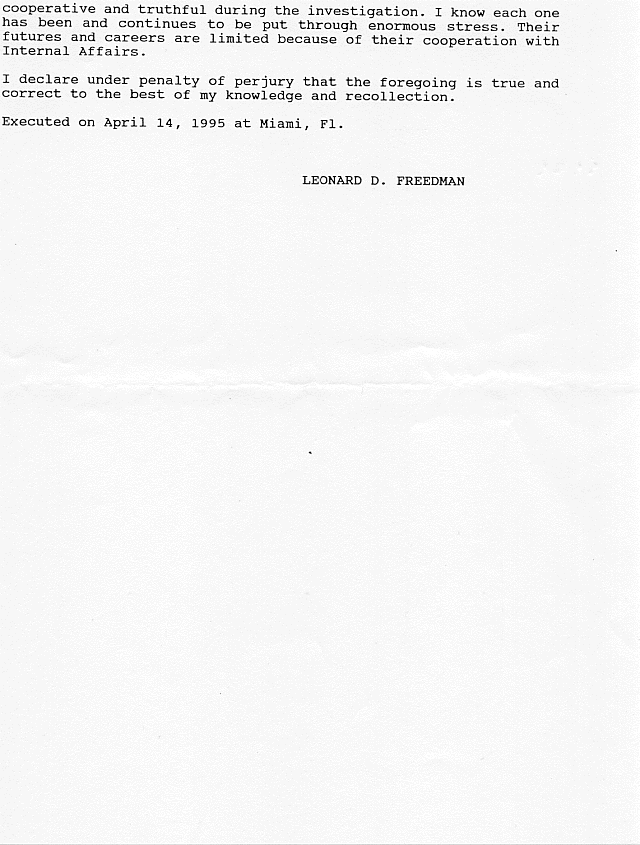
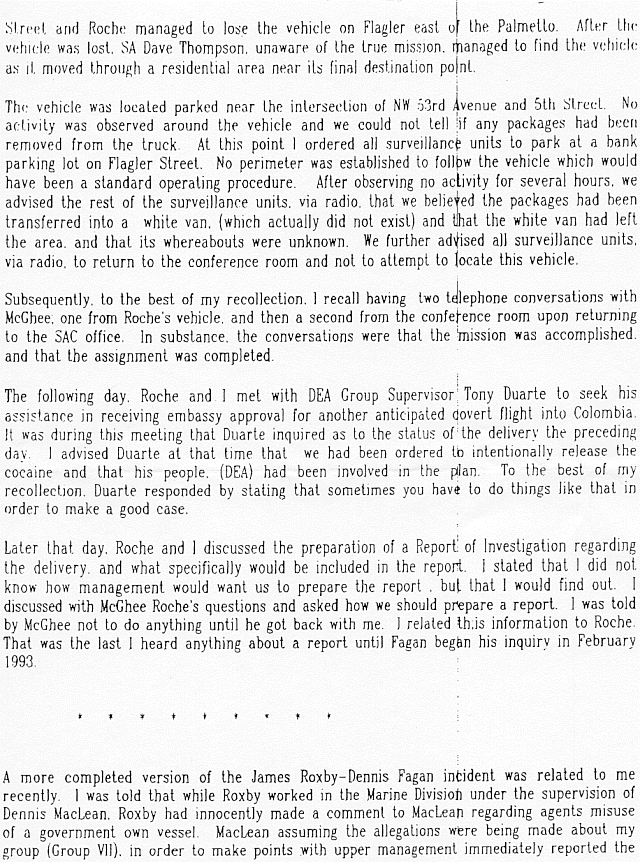
SUBJECT: Discrimination complaint of Robert C. Kammer V Robert Rubin
Secretary of the Treasury, TD Case Number 95-2074 (Leonard Freedman is
the former IA Regional Director of the Customs Dept.)
Un-sworn Declaration Under Penalty of Perjury
In accordance with the provisions of 28 U.S.C.-1746,
I the undersigned, Leonard D. Freedman, do hereby make the following
unsworn declaration, under penalty of perjury, pertinent to the above
stated subject: PAGE#1 PAGE#2
PAGE#3 PAGE#4
PAGE#5
The following affidavit is a sworn statement
of Darlene Fitzgerald-Catalan given on September 18, 2001, in the State of
Kentucky. This statement is on behalf of The Government Accountability
Project (GAP), Washington, D.C. in support of Senate Hearings for the
Whistleblower Protection Act (Senate Bill # S. 995). Click
Here to Read her testimony
Here's
the response from one of the illiterate sycophants still employed by the
customs dept.
Sent: Tuesday, October 30, 2001 5:06 PM
are
you happy now your a tattletale were all so proud
Darlene
Responds
First off , I would comment on
how the sender of this message is illiterate! "Your" is supposed
to be you're and "were" is supposed to be we're
and they failed to capitalize "are" at the
beginning of the sentence and failed to end the interrogatory sentence
with a question mark. Second off I would state the following:
If your definition of a tattletale is one where a person chooses the path
of courage and makes the difficult decision to NOT look the other way to
injustice. Then you are correct. I am a tattletale. If you mean that by
speaking out about corruption instead of cowardly staying quiet, then you
are right. I am a tattletale. If you're definition of tattletale
includes demonstrating loyalty to fellow agents and inspectors who have
chosen to stand up for others who will not sit idly by and pretend not to
see injustice, unfairness, cronyism, and corruption, then once again, I'm
guilty of being a tattletale.
I proudly admit to being a tattletale. I, unlike most cowards, have chosen
to speak out about injustice, cronyism, and corruption like many of my
brave forefathers have done. May I remind you of just a few of my fellow
tattletales that I am proud to be in great company of:
Patrick Henry who stated, "Give me liberty or give me death!"
Naval Admiral Dewey who stated, "Damn the torpedoes, full speed
ahead!"
M. Scott Peck, M.D. Author of The Road Less Traveled, "I have come to
conclude that evil is real. It is not the figment of the imagination of a
primitive religious mind feebly attempting to explain the unknown. There
really are people, and institutions made up of people, who respond with
hatred in the presence of goodness and would destroy the good insofar
as it is in their power to do so." "They hate the light and
instinctively will do anything to avoid it, including attempting to
extinguish it."
Jesus Christ - Matthew 22:14; and Matthew 20:16 - "Many are called,
but few are chosen."
Martin Luther King, Jr., "I have a dream.....a dream of a nation
where they will not be judged by the color of their skin but by the
content of their character."
Poet Robert Frost, "Two roads diverged in a wood, and I - I took the
one less traveled by, And that has made all the difference.
So my friend, as you can clearly see, I am in great company with what you
would call tattletales. I choose to use some more appropriate words like
Whistleblower, Patriots, & Soldiers of Courage. It is we
tattletales, as you would call us, who have shaped the future for our
great country. It is we who have demonstrated courage in the face of
adversity and nay-sayers like yourself. It is we who have stood up and
fought the good battle against injustice and corruption.
I have a question for you, TELL US WHAT YOU HAVE DONE TO SHOW COURAGE
TO PROTECT THE RIGHTS OF OTHERS AT GREAT PERSONAL RISK, as
the rest of we "tattletales" have done. When was the last time
you grew a spine and spoke out against injustice at great risk to
yourself? Before YOU sit in judgment of us, I suggest that you grow a
spine and take a walk in our shoes.
Sincerely,
Darlene Catalan
Former Special Agent, U.S. Customs
Proud Whistleblower
and Author of U.S. Customs, Badge of Dishonor
You folks may
wish to email a response to Lyle's Cave...I mean Lyle Cave at lcgc52@gallatinriver.net
and ask him what he has against the truth?
Check Out This Vital Website
http://www.badreferences.com/
This Customs Memo, which was provided from a
confidential Customs source, is from Raymond W. Kelly, dated September 13,
2000.
A Customs Special Agent said it best after he
retired. He said what he left was ãa leaderless, lethargic, morally
bankrupt, ineffective agency that had been infected by the Peter Principle
for many yearsä before he arrived. He then went on to say that ãthe
Customs Service has now reached such an advanced stage of internal decay
that it functions only in theoryä. I think the following memo in large
part explains this and how the reign of such inept and disgraceful
managers such as Bonni Tischler and Chuck Winwood is allowed to continue.
Iâm sure most Americans would not imagine that the secret process
described in Commissioner Kellyâs memo could exist in the United States
in the year 2001. The hated English secret ãStar Chamberä courts were
abolished in 1641, but they are still active in todayâs United States
Customs Service! The arbitrary, secretive proceedings described in this
memo are in direct opposition to the personal rights and liberty
guaranteed to all Americans by the Constitution. Unfortunately the only
things that this memo does guarantee is more Customs corruption and more
clones of Bonni Tischler and Chuck Winwood. This memo is outrageous.
(PAGE ONE
| PAGE TWO)
It is further proof of discrimination, unfair labor
practices and possible violations of Federal laws dealing with the Privacy
Act and FOIA laws within the U.S. Customs Service. This Memo was allegedly
sent out to ALL Customs employees regarding the "Selection Review
Process". It outlines the illegal use of an applicant's "entire
past record" which may be "old" or "unverified"
information. It is also a violation of the Union Contracts and Memorandum
of understanding and possible Civil Rights violations with regards to
releasing negative information about an Employee which causes unfair
considerations for a new position or a promotion. It is also against the
law to keep such "secret files" on anyone without divulging the
existence of such a file. This information is clearly being denied and
kept "secret". In doing so, it prevents anyone from being able
to defend themselves in a legal process in which our Democratic form of
government was founded. ~Editor~
Explosive
Letter from a Customs employee
Affidavit
filed by Customs employee
|
 Customs
Agent Ricardo Sandoval
Customs
Agent Ricardo Sandoval
Update: Still
Fighting to Get Awarded Damages! Jan. 8th hearing: Results in original
ruling being upheld in 9th Circuit Court of Appeals. U.S. Customs ordered to
pay, but still no relief for Mr. Sandoval as of April 20th, 2001.
Special Agent Ricardo Sandoval is still
fighting to get his awarded damages from the May 1998 court decision
by a San Diego federal jury under federal District Judge Judith Keep. A
settlement hearing is scheduled for January 8, 2001. ( Almost two full years
since he was awarded $200,000 for doing his job in the face of opposition from
his superiors at U.S. Customs Internal Affairs.) Special agent Sandoval has
experienced retaliation for doing his job and is still being harassed by Customs
managers and co-workers.
 Lawsuit Puts Customs Service on Trial Part 1
Lawsuit Puts Customs Service on Trial Part 2
Customs agent is awarded $200,000 | Jury says he faced bias and retaliation
It has just been learned that Customs Special Agent Ricardo
Sandoval has finally received his final check for the $200,000 damages regarding
his 1st lawsuit against U.S. Customs which was decided back on or about May 14,
1998. The U.S. Treasury check was hand delivered by a special courier and signed
for on or about May 11, 2001 and cleared on May 21, 2001. READ
FULL STORY
UPDATE: Though Mr. Sandoval has received
his settlement, he has reported that he is continuing to experience harassment.
Update to this Case: As a result of John Carman
giving agents a heads-up, a surprise inspection was performed in early morning
hours resulting in this story: Surprise
check uncovers 1,018 pounds of marijuana hidden beneath five railway cars.
To this day, investigations are still being covered up...
 "Railroad
Investigation Killed"
"Railroad
Investigation Killed"
It has come to my attention over the last several months that one of several
major "NARCOTICS" investigations has been "killed" by very
high Customs Office of Enforcement (O.E.) SAIC's and RAC's in the Southern
California area.
I have also been told by very reliable sources in Customs, as well as former
Customs agents and state and local law enforcement officials on various
narcotics tasks forces, that one of the most major investigations into smuggling
by the U.S. railroad has become a major corridor through which tons of
"marijuana" and "cocaine" are entering into this country
"unchecked" everyday without inspection. (I am told that this
information is well documented through official reports within the Customs
agency and well placed in case of any further death threats and harassment by
rogue Customs Internal Affairs units or corrupt officials within Customs itself)
I have also been told that maybe these "other" suspected
"government agents" that have been involved in intercepting drug
shipments may be from another government agency out of Langley, Virginia. That
remains to be seen.
 Just two years ago a railroad car was checked on a tip from reliable informants
and over 8 tons of marijuana was discovered with an additional amount of
cocaine. (Each railroad car, tanker, bin, or hopper can carry upwards of over
50,000 pounds of contraband each load. In some instances the various rail cars
can carry a maximum load of approximately 88,000 kilos or 193,600 lbs. of
contraband.
Just two years ago a railroad car was checked on a tip from reliable informants
and over 8 tons of marijuana was discovered with an additional amount of
cocaine. (Each railroad car, tanker, bin, or hopper can carry upwards of over
50,000 pounds of contraband each load. In some instances the various rail cars
can carry a maximum load of approximately 88,000 kilos or 193,600 lbs. of
contraband.
Since I worked in U.S. Customs at the San Ysidro Border Inspection Station for
over 15 years, I had occasion to inspect the "northbound" trains
entering into the U.S. via Tijuana at San Ysidro just east of the main Port of
Entry. (This is located just east and up the hill where over 6,000 vehicles and
pedestrians enter daily from Tijuana, Mexico. San Ysidro is the world's largest
land border port serving approximately 24 entry lanes with a potential maximum
load of over 14,400 vehicles and pedestrians per 24 hour shift, if ALL the entry
lanes were fully staffed and maintained.)
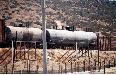 On occasion I was sent to accompany another Customs inspector and verify the
serial numbers of the rail cars as they entered the country from Tijuana,
Mexico. I also did this in Calexico, California at the Port of Entry, now called
Border Inspection Stations. We would then receive the appropriate manifests from
the rail road crew listing the various rail cars and their cargo contents. Most
ALL of the rail cars that contained cargo were sealed and required special
equipment or assistance in order to check or verify the cargo.
On occasion I was sent to accompany another Customs inspector and verify the
serial numbers of the rail cars as they entered the country from Tijuana,
Mexico. I also did this in Calexico, California at the Port of Entry, now called
Border Inspection Stations. We would then receive the appropriate manifests from
the rail road crew listing the various rail cars and their cargo contents. Most
ALL of the rail cars that contained cargo were sealed and required special
equipment or assistance in order to check or verify the cargo.
(What's interesting to note is that there is only ONE rail car weigh station in
Colton, California that can be used to verify the weights of the manifested
weights of the cargo. The only other weigh station is allegedly in Texas). All
other empty rail cars had to be checked "visually" as they entered.
NONE ARE WEIGHED. According to Customs laws, anything that entered the United
States was subject to inspection. (ref: 19 USC 482, 1581, just to name a few
laws)
The rail cars are supposed to be in such an order that the paperwork is easily
checked off for verification of serial numbers and is properly manifested. After
one of us unlocked the high security gate lock we would position ourselves on
either side of the rail cars along with Border patrol to control the entry of
the rail cars and prevent any further illegal entry of illegals. Once the rail
cars were all accounted for and secured on the north side of the border, the
gate is secured and locked once again. (It should be noted that the gate is NOT
manned 24 hours a day and is only checked a maximum of 1 hour each day for
northbound traffic. All other times it is NOT maintained.
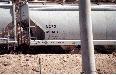 Special Note: On several occasions these rail cars were NOT in proper order and
there were discrepancies noted. On other rare occasions, the
"railroad" personnel took the liberty of letting the railcars in at
their convenience and NOT the convenience of the U.S. Customs Service. On
several other instances the northbound gate lock had been totally broken into
and the gate left open by smugglers. You could have driven a couple of trucks
through that gate, not to mention a whole railroad full of rail cars.
Special Note: On several occasions these rail cars were NOT in proper order and
there were discrepancies noted. On other rare occasions, the
"railroad" personnel took the liberty of letting the railcars in at
their convenience and NOT the convenience of the U.S. Customs Service. On
several other instances the northbound gate lock had been totally broken into
and the gate left open by smugglers. You could have driven a couple of trucks
through that gate, not to mention a whole railroad full of rail cars.
U.S. Border Patrol Agents are usually stationed near by to watch and prevent any
possible entry of "illegals" coming from Mexico while the rail cars
enter from Tijuana. I occasion I have spotted and intercepted Mexican illegals
trying to hitch a ride on board the railcars. This is very dangerous and
hazardous as some illegals have lost their lives due to train accidents from
trying to board a moving train or from exiting before the train stops. They
usually hide in the "empty" cargo bins or open rail cars that contain
no cargo.
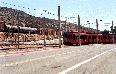 Not only is there the threat of illegal "human cargo" but the threat
of narcotics coming in by the tons.
Not only is there the threat of illegal "human cargo" but the threat
of narcotics coming in by the tons.
According to very "reliable" sources in the government and other law
enforcement agencies, there was information that tons of narcotics was entering
into the United States by way of special rail cars. This is NOT a new scenario.
According to a 1998 seizure which occurred at the railroad near one of the
border stations, over 8,000 pounds of marijuana and cocaine was discovered and
seized by Customs agents. Two years later the same railroad yard was still
experiencing problems with theft and pilfering of merchandise totaling over
$11,000,000 million dollars worth of cargo each year. Think about it. That's a
lot of expensive cargo without the threat of illegal contraband.
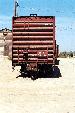 While conducting a special investigation regarding these reliable
"sources" Customs Agents and other law enforcement officials came
across a situation where there were two "independent" and
"different" sources of information that confirmed that there were
"U.S. Government" or "law enforcement" looking types that
were committing thefts on some of these "special" rail cars after they
were being held for further processing and maintained before the final the
destination was completed. Some of these "U.S. Agent" look-a-likes had
short haircuts and carried AK-47's for protection while unloading contraband.
Which agency issues AK-47's to it's agents? (According to other government
agents I have spoken to, no legitimate U.S. agency issues AK-47's at this time)
While conducting a special investigation regarding these reliable
"sources" Customs Agents and other law enforcement officials came
across a situation where there were two "independent" and
"different" sources of information that confirmed that there were
"U.S. Government" or "law enforcement" looking types that
were committing thefts on some of these "special" rail cars after they
were being held for further processing and maintained before the final the
destination was completed. Some of these "U.S. Agent" look-a-likes had
short haircuts and carried AK-47's for protection while unloading contraband.
Which agency issues AK-47's to it's agents? (According to other government
agents I have spoken to, no legitimate U.S. agency issues AK-47's at this time)
 When word of this reached Customs agents working this investigation heard of
this, they passed this on to their superiors for further investigation and
permission to pursue search warrants and arrest warrants dealing with the
narcotics that was entering through the use of these rail cars.
When word of this reached Customs agents working this investigation heard of
this, they passed this on to their superiors for further investigation and
permission to pursue search warrants and arrest warrants dealing with the
narcotics that was entering through the use of these rail cars.
What happens next is very puzzling. According to the "government"
sources, the SAIC's and RAC's "ordered" the investigation stopped
immediately. There was a very aggressive tone to this order and NO reason was
given. The agents working this case were not only "ordered off" the
investigation, but they were further "threatened" with various types
of retaliatory "administrative" actions and reprimands that were
totally uncalled for. It was obvious to these good Customs agents that they were
being told to "back off" and "stand down". When one or two
of the agents asked about the status of the investigation when he/she was told
they were possibly going to be removed, the SAIC told them "the
investigation is dead". That is was going no where. They were further told
that any pursuit of this investigation would be cause for removal.
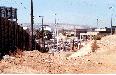 WOW! There you have it! A high ranking Customs official ordering his own Customs
agents off of an investigation for no apparent reason or justification.
(Information has it that one of these high ranking Customs officials retired
within the year to the private sector) The harassment still exists against the
remaining loyal and hard working Customs agents and several others who resigned
in order to avoid the fallout of the corrupt agency.
WOW! There you have it! A high ranking Customs official ordering his own Customs
agents off of an investigation for no apparent reason or justification.
(Information has it that one of these high ranking Customs officials retired
within the year to the private sector) The harassment still exists against the
remaining loyal and hard working Customs agents and several others who resigned
in order to avoid the fallout of the corrupt agency.
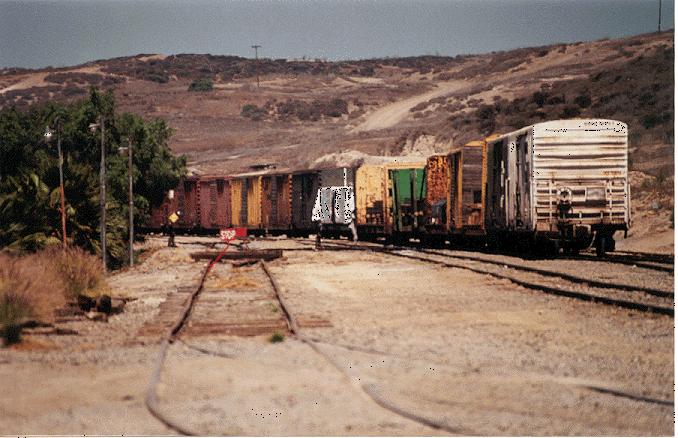
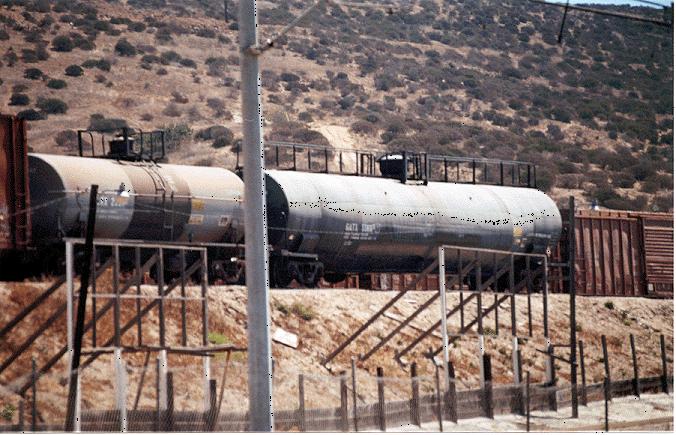
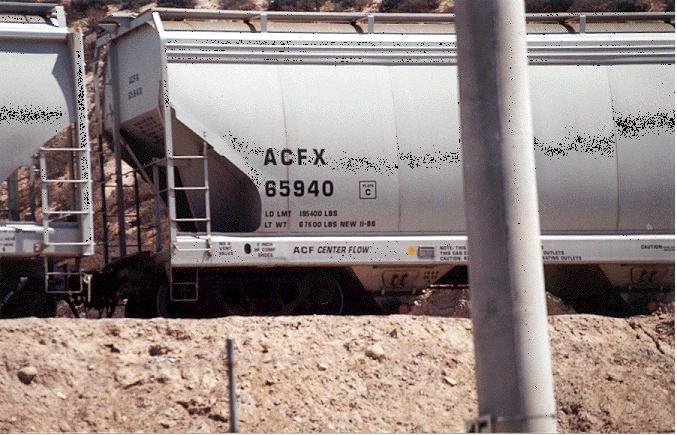
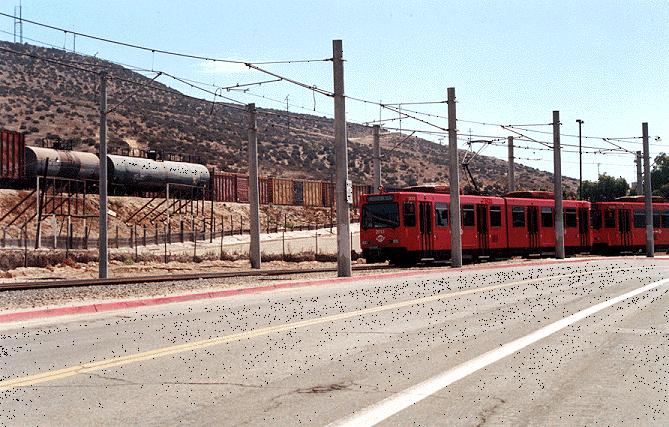
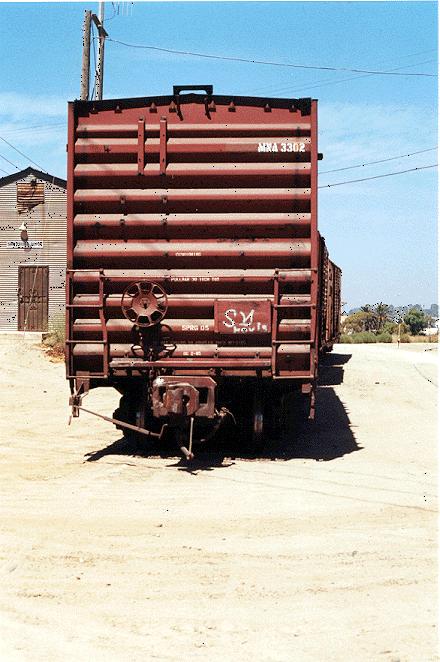
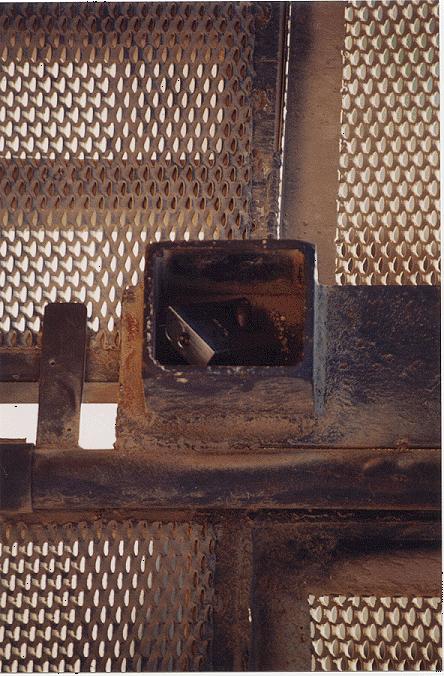
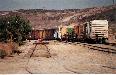
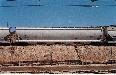
Please see the attached "sample" photos and you will see various types
of rail cars that enter the United States everyday. These particular photos were
taken at the San Ysidro Port of Entry just last month September 2000. To my
knowledge, none of these pictured rail cars are under any current investigation
for smuggling.
This information was passed on to Customs Internal Affairs and the Treasury OIG
without any positive results. The FBI and the Department of Justice was also
notified by myself as well as several others from within the Customs Service
without any response. (The FBI contact was special agent Robert W. Meza in the
San Diego office (619)514-5860 or (619)565-1255 ) This was done around April or
May of 1999. Here it is October 2000 and still NO response.
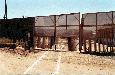 Failure to take action on direct evidence of corruption or smuggling activity by
members of the U.S. Treasury Department, U.S. Customs Service, or the FBI of the
Department of Justice is a felony and dereliction of duty and obstruction of
Justice. There are only a few instances where such an important investigation is
NOT pursued. Neither of those situations have been cited as the reasons for
killing the investigation regarding the railroad smuggling cases and the failure
of the Customs Supervisory officials from taking appropriate action.
Failure to take action on direct evidence of corruption or smuggling activity by
members of the U.S. Treasury Department, U.S. Customs Service, or the FBI of the
Department of Justice is a felony and dereliction of duty and obstruction of
Justice. There are only a few instances where such an important investigation is
NOT pursued. Neither of those situations have been cited as the reasons for
killing the investigation regarding the railroad smuggling cases and the failure
of the Customs Supervisory officials from taking appropriate action.
FOLLOW-UP
http://sanantonio.bcentral.com/sanantonio/stories/2001/10/08/story1.html
| Over the past several weeks,
we as a nation have been on high alert, open to unprecedented incursions
into our privacy in the effort to stem the threat of terrorism. We have
been willing to endure luggage searches and long waits at our airports,
metal detectors at our borders, and pat downs at our sporting events.
All this is being done as part of the united effort to prevent the
terrorists from coming to us. But what if our enemies aren't coming?
Instead, what if they are plotting to bring the horror of terror into
our communities from remote locations? That is precisely what former
U.S. Customs Service special agent Darlene Fitzgerald-Catalan asserts
that we must guard against. Catalan claims further that she has evidence
to back up her warnings. That evidence points to our nation's railroad
system. Catalan, as well as other government whistleblowers, claim that
the nation's railcars -- and the system that is used to transport them
to every nook and cranny of the country -- can be used by terrorists as
weapons to inflict devastating harm on Americans. Catalan adds that the
government must take action now to deal with the threat. The issue first
came to light, according to Catalan, during a major investigation she
helped spearhead in the late 1990s. The investigation, she adds,
uncovered a narcotics smuggling operation in Southern California that
was making use of railcars to move illegal drugs across the Mexican
border into the United States. Catalan claims that higher-up Customs
managers mysteriously "torpedoed" her investigation, which she
contends linked the smuggling operation to the Arellano-Felix drug
cartel in Mexico. Catalan alleges that in the wake of trying to blow the
whistle on the "torpedoed" investigation, she was subjected to
retaliation and severe emotional abuse, which included a death threat,
that eventually led her to resign from her job in 1999. "I had
seized eight thousand pounds of marijuana and 32 kilos of cocaine in a
pressurized rail tanker car," Catalan recounts in a recent
statement prepared for the Senate Governmental Affairs Subcommittee on
International Security, Proliferation and Federal Services. She adds in
the statement that the drugs were shipped into the United States from a
rail yard in Guadalajara, Mexico, that "was under the direct
control of the infamous Arellano-Felix (drug) cartel. Catalan's
statement was originally submitted to the Senate subcommittee in July in
support of proposed amendments to the Whistleblowers Protection Act.
Catalan redrafted the statement in the wake of the Sept. 11 terrorist
attacks and has sent copies to every U.S. senator, numerous U.S.
representatives as well as the Government Accountability Project (GAP)
in Washington, D.C. -- which is lobbying in support of reforms to the
Whistleblowers Protection Act. Doug Hartnett, a spokesman for GAP, says
Catalan's redrafted statement was submitted to the Senate subcommittee
this week. "This information (concerning the possible use of
railcars by terrorists) isn't something that dedicated terrorists
committed to blowing something up couldn't figure out on their
own," Hartnett says. By making this information public, the goal is
not "to put Xs on our vulnerabilities," but rather to get our
government agencies to adjust to the threat, Hartnett explains. "To
not do anything for fear of evildoers getting ideas is kind of what put
us in the situation we are in. There were people pointing out the lax
security at our airports long before the Sept. 11 attacks." Former
Customs special agent Sandy Nunn submitted a similar statement to the
Senate subcommittee in July as well. Nunn, who also resigned from her
job at Customs in 1999, has joined Catalan in blowing the whistle on the
aborted railcar investigation. "After further investigation,
Darlene determined that ... well over 100 of these tanker cars with
similar weight characteristics and so forth had passed into the commerce
of the United States undetected by inspection and investigators,"
Nunn says in her statement to the subcommittee. "What was in those
tanker cars remains a mystery." Who's listening? Over the past two
years, Catalan says she and several other current and former Customs
employees, including Nunn, have attempted to spur investigations into
why the railcar smuggling investigation was shut down. Among the
agencies they have contacted are the FBI and the U.S. Office of Special
Counsel. "Seven of us laid this rail operation out to the
FBI," Catalan explains. "We made this problem crystal clear in
terms of how these railcars can be controlled." She says, to date,
no one in the government has done anything. After consulting with her
attorneys, Catalan says she was convinced that it was time to come
forward with additional information on the railcar investigation,
particularly in light of the Sept. 11 terror attacks. "They (the
attorneys) said I have an obligation to go public," Catalan says,
"that I can't wait until after something gets blown up, only to
say, `I told you so.'" And so, Catalan is making available to the
media the same statement she sent to congressional members and GAP.
According to that statement, the same railroad tanker cars being used to
smuggle drugs could easily be converted for use in an even more sinister
smuggling operation: "... These (rail) tanker cars are the perfect
instruments for a terrorist attack against the U.S. As previously
stated, anyone with cash and phony identification can lease or sublease
these cars using a front company as the importer/exporter of record. ...
The terrorist would simply lease/sublease a tanker car -- even more
easily accomplished south of the U.S. border -- and pay cash to set up
an account with any of the major railroads. "... These tanker cars
can be remotely sent to any railroad spur that is put up for lease by
any private industry/citizen willing to lease their spur. ... Then the
terrorist can remotely move them and, if need be, abruptly change the
routing of these cars via a simple phone call to their customer service
rep or via the Internet, from anywhere in the world." Catalan, who
is trained in counter-terrorism tactics, goes on to state that these
"metal, cylindrical-shaped" rail tanker cars could easily be
converted into giant "pipebombs" that could be detonated
remotely. Who's watching? Catalan, in her statement, asserts that
pressurized rail tankers are not being systematically checked by Customs
as they cross the border. That claim is backed up by sources within
Customs who explain that there are thousands of railcars crossing the
Mexican and Canadian borders daily and inadequate resources to
thoroughly check each one. Further, in the case of pressurized tanker
cars, special hazardous materials teams need to be called in to complete
inspections, an expensive and time-consuming process. John Carman, a
former uniformed officer with the U.S. Secret Service as well as a
former U.S. Customs Inspector, agrees with that analysis as well. Carman
says he was among the first people within Customs to identify the
railcar smuggling problem, and, along with Nunn, Catalan and others, has
been instrumental in blowing the whistle on the lack of attention to the
issue. "If I can smuggle drugs on these railcars, I can smuggle
anything," Carman explains. "Customs simply does not have
enough time or people to inspect all of these railcars. If one or more
of these railcars (loaded with explosives or biological agents) got
through, it could do a lot of damage." That fact is underscored,
Catalan adds, by the vastness of this nation's rail system. "Now
consider the fact that one can simply remotely send these giant
instruments of death, simultaneously, to any one of thousands of rails
spurs, virtually undetected," Catalan says in the statement
prepared for the Senate subcommittee. "... Now add to this the fact
that once this is done, the perpetrators will be extremely difficult to
trace and no suicide bombers are needed." Catalan says rail spurs
are located near major buildings throughout the country. She adds that
an even more frightening scenario would be if one or more
explosive-laden rail tanker cars were to be detonated in a major urban
rail yard -- where hundreds of other railcars loaded with hazardous
materials are located. "These tanker cars in general carry a
plethora of hazardous material," Catalan told the Business Journal.
"If one or more is blown up in a rail yard, it could start a
devastating chain reaction." Catalan contends that a task force
needs to be organized immediately that is well-trained to address the
rail threat. Officials with U.S. Customs headquarters in Washington,
D.C., did not provide comment on Catalan's claims and the potential
railcar threat by the Business Journal's deadline. John Bromley,
spokesman for the Omaha, Neb.-based Union Pacific Railroad Co., says the
railroad does track information on railcars such as weight, destination
and the type of commodities being transported. "But we don't
inspect the cars to ensure the commodity that is supposed to be in them
is actually in there," he adds. "We do not open the cars. If
someone in the government is doing that, I can't say." Bromley did
say, though, that the railroad is on high alert in the wake of the
recent terror attacks and is taking steps to address security concerns.
"We have increased security on the railroad due to the Sept. 11
attacks," he explains. "But we can't discuss scenarios or what
might happen. ... "However, we are concerned with hazardous
materials and our infrastructure and other issues, and we are taking a
hard look at it with our security teams and have been meeting with
government officials."
To see other Business Journal coverage of U.S.
Customs, go to http://sanantonio.bcentral.com/sanantonio/stories/2001/10/01/story2.html
.
John Carman also operates a Web site at: ( https://www.customscorruption.com |
U.S.
report ties Mexican tycoon to crime empire
Family denies illegal acts on either side of border
06/02/99
By Tracey Eaton / The Dallas Morning News
MEXICO CITY - Mexican billionaire Carlos Hank Gonzalez, his two sons and
their associates oversee a sprawling criminal and business empire that
stretches into the United States, says a new report by a U.S. Department of
Justice agency.
"Several years of investigative information strongly support the
conclusion that the Hank family has laundered money on a massive scale,
assisted drug trafficking organizations in transporting drug shipments and
engaged in large-scale public corruption," reads the report's executive
summary, which was obtained by The Dallas Morning News. "Through
its financial strength, political influence and criminal associations the
Carlos Hank Gonzalez family remains a central, dynamic force in Mexico."
Members of the family, which has wielded immense political and economic
power in Mexico for decades, could not be reached for comment.
They have vehemently and repeatedly denied any criminal ties. Carlos
Arguelles, a spokesman for Mr. Hank Gonzalez, has called such accusations
"a pack of lies."
"It seems to be the same information regurgitated over and over. From
our standpoint, it's not true," said Richard Stern, a lawyer with
Marketing by MIR, a California firm associated with the Hank family's
sports-betting outlets in Mexico.
The report was prepared by the National Drug Intelligence Center, a federal
agency under the Department of Justice. Run mostly by former agents from the
Drug Enforcement Administration and the Federal Bureau of Investigation, the
agency reviewed more than 70,000 U.S. law enforcement documents before
concluding that the Hank family has links to Mexico's criminal syndicates,
including the violent Arellano-Felix drug gang in Tijuana and the Juarez
smuggling cartel.
The agency, based in Johnstown, Pa., was established in 1993, has a $30
million annual budget and produces coinfidential reports for counternarcotics
agencies and key policy-makers.
'Signficant threat'
It specializes in developing intelligence on worldwide criminal
organizations that threaten U.S. security interests. And its report on the
"Grupo Hank" alleges that the family and its associates "pose a
significant threat to the United States."
"The Hank family has purchased, or exercises control over, several
U.S. banks, investment firms, transportation companies, and real estate
properties," the report says.
"Carlos Hank Gonzalez's family associates closely with the leaders of
the largest organized crime groups in Mexico through business partnerships,
cooperative criminal activity, and personal relationships," the report
says.
The suggestion that there may be links between one of Mexico's most
powerful families and organized crime is especially relevant now as contenders
for the Mexican presidency jockey for position.
The ruling Institutional Revolutionary Party, of which Mr. Hank Gonzalez
has been a prominent leader for decades, has dominated the country for 70
years. Foes of the party say that it has remained in power so long, in part,
because it has accepted money from criminals.
Said the report, "Unquestionably, the Carlos Hank Gonzalez family's
greatest strength has been its political influence. As a PRI loyalist since
the 1940s, Carlos Hank Gonzalez held some of the highest political offices and
built a network of political allies. The current government is replete with
individuals who owe their careers to Carlos Hank Gonzalez."
Mexico City's El Financiero first disclosed on Sunday the National
Drug Intelligence Center report on the Hank family.
Government ties
Mr. Hank Gonzalez, 71, nicknamed "The Professor," began his
career as a rural schoolteacher, rose through the ranks of the PRI and held
several posts in government, including Mexico City mayor, Mexico state
governor and federal secretary of tourism.
He retired from politics after Mexican President Ernesto Zedillo took
office in 1994 but continues to attract attention - and controversy - in
Mexico.
"Carlos Hank Reappears," read a headline in Sunday's Reforma
newspaper, reporting that Mr. Hank Gonzalez attended his granddaughter's
wedding on Saturday after a short hospital stay earlier in the week. Some
Mexicans have speculated that his health was failing; his aides said he merely
had a checkup.
In any case, his granddaughter's wedding in Mexico state showed he still
has considerable clout. The guest list of more than 1,500 included former
President Jose Lopez Portillo, several Cabinet members, governors and assorted
other VIPs.
Inroads in U.S.
The family has tried to extend its reach into the U.S. gambling industry,
the report said. Mr. Hank Gonzalez's youngest son, Jorge Hank Rhon, operates a
string of sports-betting outlets and the Caliente dog track in Tijuana and
wants to expand into the United States, according to the agency.
The older son, Carlos Hank Rhon, has controlling interest in Laredo
National Bank and other business enterprises.
Robert Tortoriello, a lawyer for Laredo National Bank, said U.S. bank
regulators have examined Carlos Hank Rhon's background very carefully and have
not prevented him from operating the bank and adding branches.
He said that if any of the allegations against Mr. Hank Rhon were true, he
has no doubt that U.S. authorities would have taken action against the family.
"Money laundering is a very serious thing," he said.
Members of Mexico's political opposition complain that the Mexican
government has done little to prevent money launderers and other criminals
from contributing to the PRI.
Link to politicians
Carlos Cabal Peniche, a suspected Mexican money launderer now in prison in
Australia, said in a recent letter to the Miami Herald that he raised
$25 million for three PRI candidates in 1994. Fifteen million dollars
allegedly went to Luis Donaldo Colosio, the PRI presidential candidate who was
assassinated during the 1994 campaign.
An additional $5 million was raised for Mr. Colosio, and after the
candidate's murder, the funds were sent to the campaign of his successor,
Ernesto Zedillo, the current president. Mr. Cabal Peniche said he raised
another $5 million for Roberto Madrazo, who won the governor's race in Tabasco
state and is now vying for the PRI's presidential nomination.
A spokesman for Mr. Zedillo said the presidential campaign contributions
were legal and properly documented with electoral authorities.
 "Fraternizing with a known smuggler and crime figure"(Millionaire-Smuggler-Crime
Figure- Jorge Hank-Rhon and Customs Port Director Jerry B. Martin) All
associated with former District Director Allan J. Rappoport and John
"Jack" Maryon who were all under investigation but Customs Internal
Affairs, FBI, or the other Federal agencies investigating did nothing about
these dangerous liaisons. It is against Treasury regulations to
"fraternize" with known Customs violators and felons. (Look at the
smiles on Jerry B. Martin and Jorge Hank-Rhon's faces in the picture.)
"Fraternizing with a known smuggler and crime figure"(Millionaire-Smuggler-Crime
Figure- Jorge Hank-Rhon and Customs Port Director Jerry B. Martin) All
associated with former District Director Allan J. Rappoport and John
"Jack" Maryon who were all under investigation but Customs Internal
Affairs, FBI, or the other Federal agencies investigating did nothing about
these dangerous liaisons. It is against Treasury regulations to
"fraternize" with known Customs violators and felons. (Look at the
smiles on Jerry B. Martin and Jorge Hank-Rhon's faces in the picture.)
This is one of the most important photos that is really worth a thousand words.
This shows a direct "relationship" between the U.S. Customs Upper
Level management and known smugglers.
I was "ordered" not to put Jorge Hank-Rhon's name into the
Customs/Treasury look out system TECS (Treasury Enforcement Computer System)
because of another Customs Supervisor named John "Jack" Maryon. (Now
allegedly retired) Jorge Hank-Rhon was later caught smuggling more currency at
LAX international airport. (History of currency violations, endangered species
act, possible narcotics, "other" serious acts, etc...)
 This plaque was dedicated to the San Diego
Zoo by then Customs Commissioner Carol Hawlett. This was regarding the rare
White Tiger, which is endangered and was previously seized by Customs Inspectors
at the Southbound lanes to Tijuana from San Diego. This Endangered White Tiger
which was owned by Caliente Race track owner Jorge Hank-Rhon was being smuggled
without proper permits into Tijuana for his personal zoo. Jorge Hank-Rhon is a
"known" Customs violator and is very close personal friends with
Customs managers here in San Diego. (Alan J. Rappoport, Jerry Martin, John
"Jack" Maryon)
This plaque was dedicated to the San Diego
Zoo by then Customs Commissioner Carol Hawlett. This was regarding the rare
White Tiger, which is endangered and was previously seized by Customs Inspectors
at the Southbound lanes to Tijuana from San Diego. This Endangered White Tiger
which was owned by Caliente Race track owner Jorge Hank-Rhon was being smuggled
without proper permits into Tijuana for his personal zoo. Jorge Hank-Rhon is a
"known" Customs violator and is very close personal friends with
Customs managers here in San Diego. (Alan J. Rappoport, Jerry Martin, John
"Jack" Maryon)
Maryon was the Branch Chief at Otay Mesa that "ordered" me not to put
Jorge Hank-Rhon's name into the TECS lookout system. Hank-Rhon is a known
violator and has smuggled hundreds of thousands of U.S. Currency into or out of
the United States on various occasions. He has also been caught smuggling into
his own country of Mexico at Mexico City and has never been incarcerated yet. He
merely pays people off and gets his way. He is very rich and operates on the
golden rule. He who has the most gold, makes the rules!
By the way, the plaque which was attached to this rather large rock, no longer
exists at the zoo. Both the rock and the plaque have disappeared and I do not
know of their whereabouts. Mr. Jorge Hank-Rhon probably got someone to have it
"removed" or he bought it for a small "donation" to the San
Diego Zoo. That's a pretty big stone it was attached to by the way. It must have
weighed about 200 lbs or more.
 A Dangerous Family - Mexico's Hanks Accused of Corruption
Report: Mexico Family Poses Threat
Filed at 8:29 a.m. EDT
By The Associated Press
WASHINGTON (AP) -- One of Mexico's wealthiest and most politically powerful
families poses "a significant criminal threat to the United States"
because of its role in drug trafficking and money laundering, according to a
U.S. government report.
The report by the National Drug Intelligence Center says Carlos Hank Gonzalez
and his sons, Carlos Hank Rhon and Jorge Hank Rhon, are connected with major
Mexican drug organizations, The Washington Post reported today.
Hank Gonzalez, a powerful member of Mexico's ruling Institutional Revolutionary
Party and former mayor of Mexico City, has held two cabinet positions in the
government of Carlos Salinas de Gortari.
The Post said the report alleges that the family used its businesses to move
cocaine into the United States and launder millions of dollars in drug money.
Because of its high-level connections, the family was sheltered from law
enforcement action, the report said.
The Hank family "poses a significant criminal threat to the United
States," the report says. "Its multibillion-dollar criminal and
business empire, developed over several decades, reaches throughout Mexico and
into the United States."
Mexico's attorney general, Jorge Madrazo, asked Tuesday about reports of the
family's alleged enterprises, replied: "No one has ever presented a
(criminal) complaint on this issue, nor has the attorney general's Office ever
carried out any intelligence work on it. I know about as much as you do about,
only what I read in the press."
The report drew on information from the Drug Enforcement Administration, FBI,
U.S. Customs Service and CIA. It said intelligence agencies had intercepted
conversations of the Hank family coordinating drug shipments at the family's
shipping company.
The investigation was begun in December 1997 and concluded earlier this year.
Spokesmen for the family denied the report to the Post. Mexican officials called
the allegations politically motivated.
Mexico's powerful Hank family goes after U.S.
prof over leak. San Diego Union Tribune 08/17/2000
Insight Magazine (November 1996) Part 1
Insight Magazine (November 1996) Part 2
Insight Magazine (November 1996) Part 3
Insight Magazine (November 1996) Part 4
Insight Magazine (November 1996) Part 5
Insight Magazine (November 1996) Part 6
"Definition of Bribery Charges 18 USC
201"
Bribery includes offers of anything of value to a Customs Official to influence
or prevent him/her from doing their jobs or enforcing the various Customs and
Immigration Laws. This obviously creates an environment of a "conflict of
interest" when you are supposed to enforce the Customs & Immigration
Laws against people that you are partying with. For example Customs Brokers and
importers are generally a "No, No".
It has even been reported to me, by several current "CONFIDENTIAL Customs
Sources" that, "not only do these Customs Officials take part in
"special parties", but that illicit drugs like cocaine are commonly
found and used by various party goers, including these Customs Officials."
(Reference: Los Angeles, Long Beach and San Diego Customs Management above GS-12
and SES Senior Executive Service personnel, GS-13, 14, & 15's)
This is why it is so important to prevent "even the appearance" of
taking bribes by certain Customs Officials at high levels. That is why we were
NOT even allowed to take advantage of even discounted travel fares on certain
airlines and cruise ships. However, the information was always to the contrary
if you were a high ranking Customs Official.
This practice of "do as I say" and "not as I do" was and
still is in full swing when it comes to the handling of most managers and
Customs Officials.
I have had current Customs employees tell me that "unless you are part of
the Supervisory "click", you can't do anything about it."
"If anyone in the Supervisory levels gets into trouble, they just cover it
up." "There's just too much dirt at the higher levels that
approximately 80%, or better, is involved in some sort of corruption, gross
negligence and mismanagement." "This is why they cover the mistakes up
quickly, so that no one will "roll over" on the rest of
Management".
This type of operation is typical of how the MOB and the KGB have operated for
years. "They get something to extort or blackmail you with, and they know
they have "complete loyalty." " "Deals are made all the time
like this. It is a way of life for these corrupt people. They do NOT know how to
operate in an honest environment."
Reliable Supervisory Customs sources have told me this is how certain
"former" and "current" Customs managers in San Diego have
been given "special treatment" by certain millionaire socialites like
Jorge Hank-Rhon in Tijuana and Tecate, Mexico. "There is a special Health
Spa in Rancho Tecate that is frequented by certain Customs officials and
millionaire Caliente Race Track owner Jorge Hank-Rhon. One example of this
illicit relationship was "former" Customs District Director Alan J.
Rappoport and his Supervisory partner John "Jack" Maryon and Jerry B.
Martin." (Quote from Supervisory Customs Source)
Once Alan J. Rappoport and his friend John "Jack" Maryon were coming
home late from Rancho Tecate Health Spa and were sneaking back across the border
very late at the Tecate Port Of Entry. One Customs or Immigration Supervisor was
told by Jack Maryon and his passenger Alan J. Rappoport, "You didn't see
us, we were never here!" (There were witnesses too)
"There are even confirmations that a former Customs Port Director at Tecate,
named Byron Peters, even had Mexican Prostitutes and drunken parties in the
official Customs House where there are sleeping quarters for the Port Director.
After hours, these Mexican "visitors" were allowed to leave. This Port
Of Entry closed at 10:00 P.M. It is hard to say which way these
"visitors" went after they left. North, South, or back to
Mexico?" (Also a quote from a confidential Customs and Immigration
Supervisory Source)
It was also confirmed that a Customs Official once caught former Tecate Port
Director Byron J. Peters in a compromising situation. This lower ranking Customs
officer then later asked Mr. Peters for a "money loan" of
approximately $10,000 or so, from Mr. Peters to a pay off some bills. Lucky guy!
What a nice Supervisor that was! By the way, loaning money to a lower or higher
ranking official is a conflict of interest and against Customs regulations. He
probably didn't even charge him any interest. Most banks won't even do that.
TO: Editor of Customs Corruption.com
Itâs been about 5 weeks since someone displayed a copy of the ãSweet
home Chicagoä article from your website in the lobby of the Customs House
in Chicago. (I urge all visitors to your web site to read this article and your
recent feature article titled, ãThe Boxä.) The Customs Serviceâs response
to the mere display of the truth has been reminiscent of Hitlerâs Gestapo
squads, or the former Soviet Unionâs KGB.
Bonni Tischer has ordered in her own personal ãGestapo squadä to root out
this mystery messenger of truth, the ãeliteä Special Investigations Unit (SIU)
of the Office of Internal Affairs. And the recent actions of Customâs
ãeliteä border on the unbelievable. They have so far flown in both a
polygraph team and a computer forensic team. In their interviews of dozens of
employees they have employed the disgusting tactic of fabricating lies, which
pitted one employee against another in an effort to get people to admit to
writing or posting the article. In one case they even made up lies that pitted a
husband against his wife. They intimidated at least one employee to allow them
to copy the contents of his home PC hard drive. Instead of investigating the
obvious indiscretions of Dick Roster, Bonni Tischer, Chuck Winwood, and Robyn
Dessaure, Ms. Tischlerâs ãGestapo squadä is intent on discovering and
punishing whoever wrote and/or displayed the article in Chicago. As of this
writing teams of at least six to eight SIU agents have been airlifted in from
Washington on three or more occasions. Already tens of thousands of the
taxpayerâs dollars have been spent on this insane witch-hunt! In my opinion
the only logical explanation for this behavior beyond destroying this honorable
but lowly messenger of truth must be to gather information for Ms. Tischlerâs
personal attorney for her threatened lawsuit against you and your web site.
The blatant misuse of the resources of the United States Customs Service to
satisfy oneâs ego and for personal gain is unconscionable and has to stop. I
implore all readers to bring this situation to the attention of their
Representatives and Senators. And if you are a Customs employee I urge you to
also report this to the Treasury Inspector General(OIG). The Customs Service is
totally out of control under its present leadership, but there are too many
dedicated and honest Customs employees out there to allow this to continue.
Please, letâs do something to stop this.
Signed, "REDACTED" for safety reasons.
And Another one...
Correction to the Tischler article.
Subject: Bonnie Tischler
John, was just advised of your website by a present RAC/OI, who is a great guy
and has always done what is best for the country, service, and his subordinates.
Needless to say he is not well liked by management, even though he can run rings
around all the "kiss asses" that made it to the top.
Now, just to fill you in on Ms. Tischler. You report that she had an affair with
an informant. I believe you may not be getting the full picture. Ms. Tischler
was having an affair with a "subordinate", who at the time was a CPO
on the East Coast, when she was the SAC in Tampa, Florida.
Tischler was informed by Internal affairs that this particular CPO, named Keith
Puig, was under investigation for drug smuggling. Tischler was told this, by
internal affairs agents in Miami, so she would stop seeing PUIG. She didn't. In
fact there are tape recordings of Tischler and Puig, because there was a court
ordered title III on Puig's phone. These recordings revealing Ms Tischler
telling Puig of all the things she loves to do to him, to include oral sex. I
know this because at the time of this investigation I was with internal affairs
Miami.
Puig was later convicted and served time in federal prison for drug smuggling.
It is my understanding that since Puig was released from federal prison for drug
smuggling she continued to have a sexual relationship with him.
Just so you know that I am not making this up. I was a Customs
"DELETED" who knew PUIG well and like I said I was with I.A. when this
was all happening. This all came about during the Charlie Jordan case.
It's amazing what one can get away with. I knew of Tischler's affair with Puig
when it was going on but didn't care until I learned of Puig's illegal
activities. Which BONNI stated she didn't care!
Ms.Tischler, in my opinion, is a discrace to the U.S. Customs Service, which I
love having been an Inspector, CPO & Special Agent for almost 28 years.
Signed: DELETED
The John Carman Report
The Truth About 60 Minutes
and the Propane Tanker Memo Incident
I have waited long enough and thought very carefully about
what I am about to reveal to you about the "alleged" Hidro Tanker Memo
that was "allegedly" signed by CMC Director Rudy M. Camacho.
I have "first hand" knowledge of this incident
only because of my association with former Customs employee Mike Horner. I also
knew what I had to do when I discovered that he may be lying for "personal
reasons" to "control" the newsmedia. This is why certain Customs
Stories were "killed" in order to protect the newsmedia liabilities.
When I started to find these things out, then I realized that someone was lying
about something. It wasn't me. I wanted to get the truth, one way or another.
I have already brought this information to the attention of
Customs Internal Affairs Agents in San Diego and Customs Headquarters through
the former and current Commissioner without any action. I have been told by
Customs Internal Affairs Agents Russel Hixon and Dave Wales that: "We are
moving forward with a criminal case regarding Mr. Horner................with
your assistance Mr. Carman." I was also told by these "agents"
that I was doing a very "Honorable" and "Correct" thing, but
I was cautious and I also knew that all they wanted to do was go after Mike
Horner and others who made serious protected disclosures. I was taking another
chance at doing my job at the cost of losing my career.
Let me point out, that my "evidence" has never
been "refuted", nor will it be "refuted" because I have told
Customs Internal affairs and other government agencies the truth. They know
this, and they will not challenge me except at great risk to themselves and
damage the "trust" which has been broken to the People Of The United
States by the U.S. Customs Service. They also will not challenge me unless they
want to damage themselves on many corruption allegations I have made against
Customs managers. They would rather do "damage control" and attack the
"messenger".
I question the abilities and the true intentions of the
Customs Service and it's Internal Affairs Units. It is apparent that they only
want to know the truth if it benefits them or the agency. Otherwise, they do not
know how to handle the real truth and to "correct" the problems that
others have suggested over many years of service to the Customs Service like I
have, as well as others.
I have been told numerous times that I would receive some
sort of protection and that what I did to assist the Customs Service was
"above and beyond what was expected of anyone". It was at great risk
to myself and my family that I assisted Customs Internal Affairs, no matter
what. I have been retaliated against and received "death threats" by
others who may carry badges. It is time that everyone know the real truth about
Mike Horner and Rudy M. Camacho.
I have been treated "unprofessionally" by Senior
Customs Internal Affairs Agents by the names of Russell Hixon and Dave Wales as
well as the I.A. SAIC out of the San Diego office. I was also receiving
"Death Threats" without any protection from the Customs Service during
this time of my "assisting" Customs in this very sensitive issue. I
figure it was my duty to tell Customs Internal Affairs as soon as I knew
something about what I knew because I had just found out that Mike Horner was
not truthful to me or others in the Media.
I didn't want this to damage my "whistle-blower"
case against Customs in any way what-so-ever. I also "collected"
valuable information that I felt was necessary to assist Customs I.A. or
"others" in the event Customs employees that I knew or talked with
were not telling the truth. I was not going to "blindly" follow anyone
no matter what. I was also very careful to ask questions and to double check
information regarding sensitive "leaks" that occurred.
As soon as I started to discover
"inconsistencies" in Mike Horner's stories, I started keeping notes
and waiting until I was absolutely sure that I must take corrective action to
report these things. You have to remember that I was also under constant attack
by Customs management and Immigration employees that didn't really know what was
going on. I was even told by a Customs Supervisor that she didn't believe that I
talked to Customs Internal Affairs. or why haven't they (Customs Internal
Affairs) arrested anyone yet? This type of comment was very stupid and could
only try to illicit some sort of response from me. I refrained anyway.
One thing that I want to make clear, is that throughout
this ordeal, I was lied to by Mike Horner and others who are still employed by
the Customs Service. I still do not trust very many people now because of it. I
was "manipulated" up to a certain degree but I have taken measures to
protect myself.
It was apparent later on, that certain Customs employees
and Mike Horner were only interested in their own personal gain and not the real
cause of exposing corruption within the Customs Service. On the other hand, I
want to commend the other Customs employees who did have good intentions and the
needs of the Customs Service. No matter what, you must still report illegal
activity and evidence of corruption. If you don't, then you are just as bad as
the corrupt officials we are trying to weed out.
Anyway, to the last days regarding the 60 Minute interviews
and the "alleged" "forged" document signed by Rudy M.
Camacho.
There were many discrepancies with the "Hidro Tanker
Memo". Unfortunately, Mr. Horner did not want to tell me a lot of things,
so I had to "dig" at the right moment. Customs Internal Affairs
couldn't do it. No body could! Only me.
I was in a perfect position to monitor and evaluate
"limited" information. I figured I was going to get to disclose my
allegations against corrupt Customs managers, but that was not the case. Mr.
Horner "controlled" the media and he wasn't interested in any other
Customs allegations accept his own. He even tried to take "ownership"
or "plagiarize" my allegations as well as others. The only people I
can blame is Customs because of how the employees are treated if they report
illegal activity like I did.
There is specific evidence that Horner even "tape
recorded' a lot of his conversations with U.S. government agents without their
knowledge. I have provided this to Internal Affairs and they have done nothing!
I was "promised" many times by Russel Hixon and
Dave Wales, that after my last disclosures in April 1997, they only wanted to
know the truth. However once they had the truth, they still did
"nothing". It is "possible" that either I was "set
up" on a small incident, which I reported to the Customs Commissioner or
the other Customs Inspectors just lied to save their own "butt". I was
even willing to take a polygraph or chemical drug to show my sincerity in
telling the truth. Nothing has happened to the others who lied. (Yet)
Around the time of the "memo" that Mike Horner
had, I also had some questions about the discrepancies in the Customs emblem of
the official Customs Stationary. I found this out too late because whatever Mike
Horner was doing was already done. I tried to "understand" why there
were some discrepancies and I looked through a lot of my own personal documents,
reports and various awards that I had received from Customs.
When I found a few original Customs documents that I proved
to be correct "originals", I then discovered that the original
signature signed by Rudy M. Camacho was in perfect order, but that the Customs
emblem was slightly obliterated in the center where the stars appeared in the
"arch" of the center emblem. The stars were removed or gone because of
a computer glitch or because of numerous photocopying.This document is still a
good document, unless the Customs Attorney or employee "forged" his
signature.
This puzzled me extremely since Mike Horner acted surprised
when I pointed this out to him after he had already done something with
"his" Hidro tanker memo.
My memos were from cash awards or evaluations that had been
changed through the grievance procedure to "excellent" and was signed
by Rudy M. Camacho. I even had some signed by Rex Applegate the assistant
Customs Director in San Diego.
The real kicker is this. These memos all
"appeared" to come from the same office at the Customs CMC Director's
office laser jet computer printer. You could not have duplicated that
"special" discrepancy unless you copied from someone else's personal
memo or obtained another copy from the Customs CMC Director's office. Mr. Horner
did not know this discrepancy to the best of my knowledge. I believe that
someone else gave him the memo. It is because of my background in the Treasury
Department and my expertise in recognizing "counterfeit" documents
that I am making this known to you, as well as Internal Affairs.(Internal
Affairs was told first!) All the information I have told Customs Internal
Affairs still hasn't benefited me in the least. Otherwise, I would not be
writing these reports and making further disclosures.
I also want you to know that there were several others in
Customs who were asked to "sign" an affidavit to confirm the existence
of this "memo" and it's authenticity in which Mr. Horner had
possession. Afterwards, Customs Internal Affairs asked several other persons to
sign an affidavit to the contrary. I was not one of those persons.
Prior to the "60 Minutes" story regarding the
"memo", I was asked to find this alleged memo in another Customs
office which Horner had specific knowledge about. I did not do anything because
of the danger to myself and the sensitivity of what he was asking. Instead, Mr.
Horner faxed me a copy of the "alleged" memo so I could look at it
myself. Unfortunately, it was "sanitized" and the signature was
"blacked" out as well as the "alleged" originators of the
memo. This was later explained to me by Mr. Horner to protect certain Customs
employees in case the "promised" protection was not fulfilled by the
Customs Service, U.S. Attorney's office, or Senator Feinstein's office and the
"60 Minute" producers and Mike Wallace. If the protection was not
afforded, then some of the other Customs Employees were to "disavow"
any knowledge of signing any affidavits for Mike Horner. Mr. Horner even made
the same promises to me and said, "If it looks good sign it". It was
very general and only claimed to be familiar with the memo and it's procedures
of allowing "special treatment" of certain importers and there special
cargo or perishable merchandise. I am very familiar with this and other similar
types of Customs memos.
I have personally seen similar types of memos signed and
"rough drafted" by the head of U.S. Customs District Director Alan J.
Rappoport, for *Aceves Trucking Company (*prior violators) and the head of
Mexican Customs named: "Monje". This would prove to anyone that it was
a common practice and occurrance to allow "favors" for certain
trucking companies by the Customs Service to enter and be waved through without
inspection because of the District Director's authorization. (Remember the
yellow laminated "get out of jail free" Camacho Cards possessed by
drug smugglers and violators?, Former District Director Alan J. Rappoport did
the exact same thing too!) I know, because I have personally caught people with
these cards that were guilty of lying or smuggling. This is what former Customs
"D.D." Alan J. Rappoport did with the Hidro Tanker trucks. He even
allowed them to come into the country through the "non-commercial"
traffic at San Ysidro "without" proper inspection for drugs.(Remember
the 8,500 pounds of Cocaine at Otay Mesa?)
Mike Horner did not know about these "other
memos" that existed to the best of my knowledge. If he did, then it was
through someone else. I found copies of the "related" memos in the
Import Specialist Branch files that I was specifically "ordered" to
"purge" as far back as 5 years or more. I got to see a lot of files
but, I was only following orders from Supervisors Patrick Talese and Stephanie
Castro and other GS-12's. It just so happened that the Team I was assigned to
dealt specifically with pharmaceuticals, drugs, chemicals, food items, jewelry,
medical devices, just to name a few.( Maybe I was meant to find those memos?)
I have provided all this and more information to Internal
Affairs without real cooperation or assistance. I have been lied to and told
that everything I did would help my case against Customs. I believe that I was
sincere, and Customs Internal Affairs and Management was not. They only wanted
to shut Mike Horner up!
I think that no matter what happens to me, you can see for
yourself what is really going on. You just have to be "open minded"
and decide whether you want to ignore something or do your job and risk
suffering the consequences of telling the truth and being retaliated against.
There is a very strong message in these reactions by Customs Management. It
clearly shows that you might stand alone some day when you have to make the
ultimate challenges of reporting illegal activity when it might not be in the
best interests of your career. I do not remember any "qualified exceptions
to the rules" when reporting illegal activity or corruption by Customs
personnel.
I was not approached by Internal Affairs. I approached
them! They seem to make a big issue with that fact.(Who called who?) I still
report illegal activities, but not through the local offices. I don't trust
them. Especially after I was "asked" by Customs Internal Affairs
Agents and SAIC's of Customs Internal Affairs to record the conversations of
"certain" Customs employees or "former" employees.
When I later questioned the legality of this activity
without the aid of a Court order signed by a Federal Judge, the SAIC of Customs
Internal Affairs screamed at me on the phone and said, "I can't talk to
you, call Special Agent Dave Wales!"
Needless to say, they all decided not to continue with that
idea. I have even heard stories about how Customs Internal Affairs Agents were
committing burglaries on the homes or residences of other Customs employees
while they are at work. (Do you know who visits your residence while you're out
protecting the United States from the likes of narcotics smugglers and dangerous
fugitives and narco-terrorists ? I do. )
Sometimes I think Internal Affairs was collecting data and
information for CMC Director Rudy Camacho and his "private" lawsuit
against "60 Minutes". Otherwise, how could Rudy M. Camacho's
attorney's get my "new unlisted" telephone number? When I moved, I.A.
had the new number and I didn't give permission for Rudy Camacho to have it
either. (I now have another new number, pending that one gets compromised)
More to come!
Bounties Of $200,000 Said
|
BROWNSVILLE - Bounties of up to $200,000 were
hanging over the heads of U.S. border enforcement officers
Wednesday.
In an advisory circulated this week, U.S. Customs
said it received bounty-like threats on federal agents after 9,000
pounds of marijuana was seized at a Brownsville home Dec. 13, the
Brownsville Herald reported. "Every time there's an operation
like this and drug traffickers take a hit, bounties and threats
frequently surface against federal agents," said Art Moreno, a
spokesman for the Immigration and Naturalization Service. INS and
Customs officials said they would continue with their duties as
usual.
Generally, organized drug cartels are behind the
threats, Moreno said. In Mexico, an official at the federal attorney
general's office in Ciudad Victoria said the threats were being
taken seriously there. "We have an alert just to prevent
something from happening related to these threats," Cmdr.
Guillermo Narvaez told the Herald.
Narvaez said federal agents in Mexico also receive
such threats, and they are usually made by drug cartels in an effort
to scare officials. Border Patrol officials said in the past there
have been similar threats against agents in El Paso and other border
areas.
|
FBI, CIA want agents in T.O.
Raids after Sept. 11 raise fears of established terror cells
By TOM GODFREY,
TORONTO SUN
The FBI and CIA are trying to beef up their presence in Canada to probe
terrorist activity that could pose a second threat to the U.S., American
officials say.
The FBI, which already has more than 40 officers in Toronto probing the Sept. 11
terror attacks, is pushing for a full-time field office here to monitor al-Qaida
and other terrorist groups.
The Canadian Security Intelligence Service has warned there are 350 terrorists
from 50 groups based in this country.
The FBI has asked Congress for more money to permanently station more agents
here to exchange information and help Canadian police in terrorist cases.
RESOURCES NEEDED
"The world of crime ... is expanding so rapidly internationally," FBI
legal attache Stuart Sturm told The Canadian Press. "This of course
bolsters that argument that resources are needed overseas for not just the FBI
but other agencies."
FBI officials in Ottawa and Washington, D.C., said the expansion will occur if
approved by Congress.
U.S. police said the CIA, which has officers based at U.S. embassies, is also on
the verge of sending additional officers to Canada.
CIA officials refused comment.
RCMP Sgt. Paul Marsh said FBI agents do not have the jurisdiction to conduct
investigations in Canada, but can work as liaison officers and observers.
"Any investigation involving the FBI has to be led by a Canadian law
enforcement agency," Marsh said. "They (FBI) could assist as
observers."
Canadian police said the FBI and CIA were stunned by the apparent extent of al-Qaida
activities in Toronto, revealed after the arrest of Parkdale refugee claimant
Nabil Al-Marabh and raids on a downtown copy shop and three local apartments.
'MOTHER LODE'
The Mounties then said they had seized a "mother lode" of evidence
that led to the detention of Al-Marabh associate Hassan Almrei as a threat to
security.
An RCMP probe into Al-Marabh's activities turned up several dozen associates in
Montreal, the U.S. and Germany.
Al-Marabh, 35, who's accused of sending cash and documents to the Sept. 11
suicide pilots, was arrested in the U.S.
Canadian police sources said U.S. officials are also furious that undocumented
refugee claimants are being released nightly, while some 6,000 failed refugees
have disappeared since their cases were rejected this year.
Police have created a special team at the Windsor-Detroit crossing to gather
intelligence to intercept border jumpers.
Closer
Look at Exports Urged
Customs Lists Items of
Potential Use to Terrorists
By Bill Miller
Washington Post Staff Writer
Tuesday, December 11, 2001; Page A14
Concerned that the nation's own products could be used by terrorists to
carry out a new round of attacks, U.S. Customs Service officials yesterday
asked American businesses to scrutinize more closely overseas orders for
technology, weapons and equipment.
Customs Commissioner Robert C. Bonner said the agency has compiled a
"shopping list for terrorist organizations" of about 100 items that
could be used to develop weapons of mass destruction or to help terrorists
evade detection or capture. In addition to seeking assistance from businesses,
the Customs Service and other government agencies are bolstering enforcement
of export laws.
"It will take a vigorous effort from everyone, including government
and the private sector, to shield America from being targeted by its own
technology," Bonner said.
Describing concerns that al Qaeda or other terrorist organizations are
seeking to develop crude nuclear weapons, he said: "It would be the
ultimate irony if they were able to obtain equipment or technology from the
United States."
Many items on the list have legitimate uses, Bonner said, but could
wreak havoc if they wound up in the wrong hands. Customs agents yesterday
began meeting with hundreds of manufacturers, businesses and distributors,
urging them to alert the government of suspicious activities. Bonner said
firms should be especially wary of first-time customers, clients offering
large sums of cash or prospective buyers willing to pay far above market price
to obtain sensitive materials or technology.
Bonner said the targeted dual-use items include chemicals such as
thiodiglycol, which has a benign use in producing dyes and inks but also can
be used to make mustard gas, and krytrons, high-speed timing devices that can
be used in photocopiers and lasers but also to trigger nuclear warheads. Over
the years, Customs agents have prevented such products from reaching nations
such as Iran and Iraq, he said.
The Customs Service is working with the State and Commerce departments
in the enforcement effort, Bonner said.
The push comes at a time when resources at the Customs Service are
stretched thin. Roughly 8,000 inspectors and canine enforcement officers are
responsible for checking passengers, vehicles and cargo shipments at more than
300 entry points into the United States. Another 2,700 agents have
investigative duties such as export control.
Bonner acknowledged that "there is a certain amount of robbing
Peter to pay Paul in terms of deploying services," and said that he was
concerned the new effort could cause delays in some fraud investigations. He
said the challenge was to maintain "the same level of intensity" in
fulfilling the Customs Service's other responsibilities.
But heightened homeland security efforts, he noted, have had benefits
beyond combating terrorism. By popping open more car trunks and looking inside
more trucks, the Customs Service has slowed down the flow of drugs into the
United States along the southwest border, Bonner said. Drug seizures this
October were 30 percent higher than in October 2000, he said.
U.S. Seeks Safe Border
With Mexico
By Julie Watson
Associated Press Writer
Friday, December 28, 2001; 2:08 PM
MATAMOROS, Mexico öö Smuggling has always thrived along the U.S.-Mexico
border, where money can buy passage for almost anything.
Now, as the United States beefs up security after the Sept. 11 attacks,
Mexico's endemic lawlessness has raised concerns that terrorists could use the
country's organized crime networks to stage future attacks against America.
The United States and Mexico are discussing border security, and the two
countries are expected to reach an agreement next year, following a recent
U.S.-Canada accord to fight terrorism along the U.S. northern frontier.
"Mexico will not be a place of residency for terrorists nor a place
of transit," Mexican President Vicente Fox said during a recent trip to
Tijuana.
But Fox has struggled to halt widespread corruption and bring down
deadly cartels. In December, five federal agents and two state police officers
in Reynosa were arrested for working for one of Mexico's most-wanted drug
lords, Osiel Cardenas.
Drug lords are "so embedded that they run things," said Louis
Sadler, a border specialist at New Mexico State University. "They know
where the creases are in the border. They know what the odds are of being able
to evade a sensory field, balloons, or whatever."
There is no evidence that terrorists have staged attacks against the
United States from Mexico. But even without corruption, government officials
on both sides of the border have expressed concerns about Mexico's lax
security and lawless culture.
Ruben Garza, a regional supervisor for Mexico's Comptroller's office,
said there were periods when luggage was moving through X-ray machines at
Tijuana's airport with no one watching. Months ago, Mexico took extra security
measures at the airport because of its proximity to San Diego.
"Anyone who has the intention of introducing arms or some kind of
device to cause harm, can do it with relative ease if they stop and observe
the security measures at the airport," he said.
In Ciudad Juarez, Republican congressional members said recently they
easily found people offering fake visas.
"We crossed over the border in Mexico, and when we got there we
asked the first person we found on the street whether it would be possible to
purchase a document in order to get into the United States," Rep. Tom
Tancredo of Colorado said. "Within about one minute, we were able to find
such a person. This makes the whole border process, to say the least,
difficult."
Mexico's borderlands are home to some of Latin America's most powerful
smuggling rings. Over the years, they have infiltrated all levels of
government, hiring officials to give them safe passage.
In November, a former immigration agent in Ciudad Juarez was sentenced
to 30 months in jail for working for a million-dollar global network that had
smuggled hundreds of Iraqis and Palestinians into the United States since
1996.
In September, the former police chief in Mexicali across from Calexico,
Calif., was jailed for allegedly warning Mexico's deadly Arellano Felix gang
of police operations.
The problem is not just Mexico's. In early December, an El Paso
immigration inspector was arrested for allegedly coordinating drug shipments
across the Rio Grande.
Sadler said terrorists could use such networks.
"These drug types are just as bad if not worse than Osama bin
Laden," Sadler said. "They are cold-blooded killers who care for
nothing or nobody and for enough money they can be had."
Yet John Bailey, a Mexico expert at Georgetown University, believes even
corrupt officials will draw the line when it comes to terrorism, figuring the
risks outweigh the bribes.
"If the rules are spelled out about what it is that Americans are
really concerned about, then corruption can coexist with security along the
border," he said.
Sadler isn't so sure.
"They might be restrained in the sense of being aware of the fact
of what the retaliation factors will be," he said. "But they could
also say smuggling people across the border is not the same as destroying the
World Trade towers. They could say 'Hey, I didn't know these guys were
terrorists.'"
Even Hector Castro, the state police commander in Matamoros across from
Brownsville, Texas, believes terrorists could use the border's networks. In
early December, Matamoros authorities arrested a migrant smuggler accused of
sneaking Pakistanis, eastern Europeans and others into the United States.
"Don't believe all terrorists come through Canada," he said.
©
2001
The Associated Press
Friday December 21 04:22 AM EST
Accused drug lord arrested in Mexico
By Tim Steller , ARIZONA DAILY STAR
One of the biggest names in drug
trafficking along the Arizona border walked into the hands of Mexican
and American agents Thursday morning.
Miguel Angel Caro Quintero, facing
drug-related indictments in Arizona and Colorado, was captured in the
northern state of Sinaloa, Deputy Attorney General Eduardo Ibarrola told
a news conference.
But his arrest had its roots in Tucson.
It fulfilled an arrest warrant originally issued here 13 years ago - the
first time Caro Quintero was indicted in the United States. Since then,
he has been indicted twice more in Tucson and once in Denver.
If Mexican courts approve an American
extradition request, Caro Quintero will be brought to Tucson for trial.
"Clearly it's a huge breakthrough in
going after the organizations that run the Sonoran corridor,"
Molesa said.
Caro Quintero faces charges of running a
marijuana and cocaine trafficking network that brought illegal drugs
from central Mexico to the U.S. border and at times dominated the
Nogales and Douglas smuggling routes.
On June 1, President Bush (news
- web
sites) named him one of a dozen "narcotics kingpins"
subject to special financial controls in the United States.
Miguel Caro Quintero's name also recalls
his even more notorious brother, Rafael.
Rafael Caro Quintero ran the same
drug-trafficking organization until his conviction for the 1985 murder
of Mexico-based DEA agent Enrique "Kiki" Camarena Salazar,
according to DEA accounts. Rafael, who remains imprisoned, was made
famous through songs and movies about the Camarena murder, including a
1990 mini-series broadcast by NBC.
The 1988 indictment traces the Caro
Quintero brothers' involvement in the drug trade back to 1982 meetings
in Caborca, Sonora, which the family had made its home base. Through the
mid-1980s, Rafael and Miguel Caro Quintero had their marijuana loads
flown across the border, dropped off in Southern Arizona and stored in
Tucson stash houses, the indictment says.
The family also branched into cocaine,
according to a 1994 indictment. That year, according to a criminal
complaint, undercover DEA agents negotiated with Miguel Caro Quintero's
underlings to bring cocaine loads from airstrips in Mexico across the
border to Tucson.
Caro Quintero had thumbed his nose at
efforts to catch him. In 1992 he was arrested by Mexican officers near
Altar, Sonora. He was able to bribe and threaten his way out of the
charges and was freed, according to DEA accounts.
But the DEA continued hounding him.
Responding to the DEA administrator's naming him as a top trafficker,
Miguel Caro Quintero telephoned an Hermosillo, Sonora, radio station in
1996, said he was simply a rancher, gave his address and invited law
enforcement officers to visit him.
But the arrest was not accomplished until
a new administration took office in Mexico City. Under President Vicente
Fox (news
- web
sites), the Mexican Attorney General's Office has established
special, vetted units to pursue drug traffickers.
They've scored a series of successes, in
particular targeting the so-called lieutenants of the Arellano-Felix and
Joaquin "El Chapo" Guzman organizations.
The Fox administration also initiated the
extradition of high-ranking suspected drug traffickers by sending Arturo
"Kitty" Paez to San Diego in May. The second such extradition
was of Francisco Rafael Camarena Macias, the alleged builder of a
Douglas drug tunnel, who was sent to Tucson in June.
In Camarena's case, it took two years
between the American request for extradition and his arrival here, said
Stephen Ralls, Camarena's attorney.
Thursday's operation was the culmination
of years of searching for Caro Quintero, in which investigators often
showed up weeks, days or even hours after he had left a given place,
Molesa said. Agents of the DEA's Hermosillo office, working with the
Mexican unit, got a tip that he was going to be at a house in Los Mochis
Wednesday night, Molesa said.
"He didn't show up at night, so they
waited, because it seemed like a promising lead. They waited till this
morning, and he showed up in the morning," Molesa said.
After Caro Quintero got out of a vehicle,
the agents approached, Molesa said, and stopped him before he could
escape.
"They stopped him at the front of
the house, before he got mobile."
* Contact Tim Steller 434-4086 or at steller@azstarnet.com.
|
Visit Our Friends At www.Giraffe.org

We're
training tomorrow's heroes.
Money
For Nothing
John
Ashcroft is spending 361 Billion Dollars on Homeland Security. After reading
this article, ask yourself: Why Bother?
Security Compromised By Mechanical Train
Inspections?
Yard Clerks Being Replaced By
Machines
POSTED: 7:57 p.m. EST February 7,
2002
ROUSES POINT, N.Y. -- A lack of
agents is the reason that 19 out of 20 freight trains that cross the
border into northern New York aren't inspected, according to Customs
officials.
Railroad workers check the outside
of the trains, but not for long.
When Canadian freight trains cross
the border, it's up to U.S. Customs to make sure that everything on the
trains is accounted for.
But not every train is checked.
Agents inspect only one out of about 20 trains that pass through each
week.
That means that often, yard clerks
at the Rouses Point railroad station are the only ones examining
southbound trains.
"Without us being there they
don't know what's going across the border because they don't check the
trains," yard clerk Paul McGuire said.
Starting June 1, the clerks won't
be there. CP Rail plans to replace them with a machine.
"It's to improve customer
service," Michel Spenard of CP Rail said. "It's part of a
realization and rationalization that we want to improve service and
information flow."
CP Rail isn't alone. Most rail
companies are now replacing human inspectors with scanning machines.
Assemblyman Chris Ortloff said he
believes the move will compromise national security.
"The system in place depends
on human beings -- not just eyes and ears but a sixth sense to watch those
trains go through," Ortloff said.
Ortloff said he's been in contact
with Congressman John McHugh to see if there's anything the government can
do in the name of national security.
Spenard agrees the company has a
certain responsibility when it comes to border security.
"Security is not just a up to
Customs, it's dependent on private companies like us as well as federal
agencies," Spenard said.
Spenard said eliminating human
inspectors doesn't threaten security, because yard workers only inspect
the outside of the trains.
Yard clerks argued that sometimes
inspections turn up the unexpected. McGuire remembers at least one time
when a train trespasser was scared out of his hiding place.
"The car had to be set off
for an extra inspection and a guy jumped off. If we hadn't seen him, the
person would have rode to their destination," he said.
Mcguire said without clerks in the
yard, it would be easier for stowaways to slip into the United States.
And while he's worried about his
own future as CP Rail brings in a machine to replace him, McGuire is also
convinced that the move opens up a hole in border security that could mean
trouble is coming down the tracks.
Freight Trains Pose Potential Terrorist
Threat
Products Carried In Freights Not
Always Checked
POSTED: 9:15 p.m. EST February 6, 2002
ROUSES POINT, N.Y. -- Border security
has been a top priority since the Sept. 11 terrorist attacks as more
attention has been focused on cars, trucks and buses coming into the United
States.
But our Focus 5 investigation
revealed an exception: freight trains.
The Rouses Point rail station, just
south of the border is the first place the trains have to stop when they
enter the United States.
Workers there call it the last line of
defense against terrorists.
Each night, three freight trains
bound for cities throughout the United States, cross the Canadian border in
Rouses Point.
Rail workers inspect the cars for
mechanical problems and make sure the railcars match up with the paperwork
provided by CP Rail.
The trains carry everything from
household items to cars, but rail workers don't actually look inside the
cars or the freight containers they carry.
That's where Customs comes in,
sometimes.
"We don't go out there every
day, nobody's out there every day," said chief inspector Mike Mullens.
"There hasn't been for over 20 years."
Mcmullen said Customs checks just
one train a week in Rouses Point because there aren't enough agents to staff
the station 24 hours a day.
So it is possible there could be
more than freight inside one of these cars, McMullen said.
"I can't say there's no chance
a terrorist will ever get through, it's impossible," McMullen said.
How can you have an open hole in the
border with nobody watching it?" assemblyman Chris Otloff, of
Plattsburgh, asked.
Otloff said the Port of Excellence
campaign planned for Champlain should help remedy the problem. It will add
agents to the mix, sending some who would be performing truck inspections
over Rouses Point to check the trains instead.
But that is still years down the
road. And in the meantime, the convenience of shipping by rail is very
appealing for local businesses.
Garry Douglas of the Chamber of
Commerce said it's the safest, most predictable way to move products. After
all, trains don't get lost.
"Unlike trucks, a train going
from Montreal to Albany is not going to take a wrong turn and go to Loon
Lake," Douglas said.
And railroad companies have to
provide detailed paperwork on the contents of each train, making it easier
for businesses to track their shipments.
CP Rail yard clerks check the trains
as they come in, verifying the Information and notifying customs if there's
a problem.
"We only go over there to
physically inspect trains when we target something or something needs to be
looked at within reason," McMullen said.
Customs acknowledged that the system
has its flaws, and yard clerks said it's only going to get worse: By summer
customs agents will be the only ones inspecting those trains.
Terror Trains
February 13, 2002
Watch out for what's coming down the
tracks.
We've all heard the cries: Tighten
border security. Keep the terrorists out. Be vigilant. Our Focus Five
reports last week show that message hasn't sunk in when it comes to the
railroad.
At the CP rail yard in Rouses
Point, the company plans to eliminate inspectors who check the trains
coming across the border. The company says a machine can do just as well.
Maybe.
But machines don't have a sixth
sense ... or an extra pair of eyes ... or experience. A machine's going to
tell if someone looks suspicious? Sorry. We don't buy that.
You'd think the U.S Customs
Service might take up the slack. But Customs says it has no plans to step
up inspections. And right now, they're only inspecting ONE TRAIN a week.
We're supposed to be on high
alert. Ready. Some of us may be.
But we'd better hope that if the
terrorists do decide to cross the border, they don't decide to do it by
riding the rails.
That's our opinion. What's yours?
Aired by President/General Manager
Paul A. Sands
|
Editors
Note: This is typical activity at the border. We also
experienced many other illegal "incursions" by
Mexican Military as well as special "escorts" for
smugglers. The police are no different and they should have
known about the Border restrictions no matter what. (Their
weapons will probably be returned to Mexico and the incident
covered up, no charges will be brought against the Mexican
officers and the U.S. Citizen "may" have gotten away
with something. It is common knowledge that U.S. Citizen
fugitives from justice are living in Mexico. Especially near
the border towns like Tijuana. .(We still do not have a strong
extradition treaty with Mexico) I have personally
apprehended many U.S. Citizen fugitives that lived in Mexico
and were either on the run or escaped felons involved in narcotics,
arson suspects, child molesters, murder suspects, NCIC
warrants, etc. Customs Supervisors took a very dim view
of my actions when I detained or arrested these violators,
even though I was just doing my job. John Carman
|
|
Two Baja
officers held after port chase
Pursuit of pickup ends on U.S. territory, near Tecate
By Marisa Taylor and
Anna Cearley
UNION-TRIBUNE STAFF WRITERS
February 14, 2002
Two Baja California state police officers were detained by U.S.
authorities yesterday after they sped through the Tecate border
crossing without stopping in pursuit of a pickup driven by a
U.S. citizen.
The police officers and
the driver of the truck were held on the U.S. side of the border
for hours, as U.S. and Mexican officials tried to figure out
what happened. The U.S. citizen was eventually released, and no
charges were filed against him. The two Mexican officers were
expected to be turned over to U.S. immigration officers for
deportation.
The high-speed chase
occurred less than a month after another border incident, when a
Mexican soldier fired into cars waiting to cross into the United
States at the Otay Mesa crossing. That shooting hasn't been
fully explained.
Yesterday's incident
began in Mexico about 11 a.m., when the two plainclothes police
officers, each driving an unmarked car, chased the pickup toward
the Tecate border crossing.
The three vehicles drove
the wrong way into the single southbound lane, bypassing cars
arriving in Mexico.
U.S. Customs Service
inspectors threw a spiked post in front of the pickup,
puncturing the truck's tires and stopping the chase on U.S.
territory, within feet of the border.
The customs inspectors
initially thought all three men were port runners or smugglers
who were trying to evade law enforcement by speeding across the
border, said Vince Bond, a customs spokesman.
But one of the men held
up a badge and identified himself as a police officer.
The U.S. citizen is said
to have yelled to U.S. authorities for help.
Officers from customs,
the Immigration and Naturalization Service and U.S. Border
Patrol surrounded the vehicles and detained the three men for
questioning. U.S. authorities haven't released their names.
During a search of the
police vehicles, Bond said U.S. authorities found two
semiautomatic guns. They also found one gram or less of
methamphetamine. Bond said U.S. authorities are deciding how to
handle the discovery of the drug.
Lu’s JimŽnez G—mez, a
Mexican state police agent temporarily in charge of the Tecate
office, said Mexican authorities went to the Tecate port after
the incident. The assistant state attorney general based in
Tijuana was still there yesterday evening.
JimŽnez said as far as
he knew, the agents didn't do anything wrong.
He said a judge had
issued a warrant about a month ago for the arrest of the U.S.
citizen, allegedly for the rape of a 12-year-old girl.
When the agents
confronted the man yesterday with the arrest warrant, JimŽnez
said he took off.
The man had been living
in Mexico and was well known by residents, JimŽnez said.
"The agents were
totally in the right because they were trying to comply with a
judge's order," JimŽnez said.
Officials on both sides
of the border were concerned about the incident at Tecate, a
small port of entry with one lane going in each direction. Its
gates are closed between midnight and 6 a.m.
"We are concerned,
because we want to continue to have good relations with the
United States," said Roberto Gonzalez, a spokesman for the
Mexican Consulate in San Diego.
On Jan. 11, a Mexican
soldier wounded three people, including a Hoover High School
student and a Mexican doctor, at the Otay Mesa border crossing.
There were reports that
the soldier may have accidentally discharged an assault rifle or
a submachine gun. But other reports indicated the shots were
fired while the military was chasing two men.
"With these
trans-border incidents, it's often difficult to get all the
facts," said Raleigh Leonard, a U.S. Border Patrol
spokesman in San Diego.
Clint Wright, spokesman
for the U.S. consulate in Tijuana, said the shooting incident
came up at a border security meeting of U.S. and Mexican
officials earlier this month.
"When something
like this happens, it has the potential of escalating into a
very serious incident that would affect sentiments on both sides
of the border," Wright said.
|
Bill would give
federal whistle-blowers right to sue employers if punished
By Lisa
Burgess, Washington bureau
European edition, Thursday, February 28, 2002
WASHINGTON
÷ Government whistle-blowers have more freedom to warn against potential
terrorist threats if a new House bill that "gives teeth" to an old law
against employer retaliation is passed, advocates said.
Dubbed the "Paul Revere Freedom to
Warn Act," the bill, introduced in the House on Wednesday by Rep. Steve
Israel, D-N.Y., beefs up existing federal laws that allow employees to speak up
if they know about potentially dangerous security shortcomings.
The Lloyd-LaFollette Act of 1912 makes
it illegal for employers to interfere with whistle-blowers.
But "while the law is clear, it
doesnât have any penalties if the act is violated," Israel said in a
Capitol Hill press event. "It has no teeth."
Sen. Charles Grassley, R-Iowa, who
attended Israelâs event, said that he plans to introduce companion legislation
in the Senate.
The existing law was passed in response
to gag orders from Presidents Taft and Roosevelt that made it necessary for
employees to get approval from their employers before communicating with any
member of Congress regarding any security lapses.
The 1912 law lifted that restriction,
but failed to provide access to courts that could enforce those rights.
The Paul Revere bill gives employees who
believe their employers have violated Lloyd-LaFollette the option of suing their
government employers in a federal court, with a jury trial to decide the
outcome.
Whistle-blowers whose employers punish
them for their actions would have three years to sue for lost wages and
benefits, reinstatement if they lost their jobs, costs and attorney fees and any
other relief the jury might decide is appropriate.
With the United States on high alert to
guard against terrorist acts, the new bill is absolutely essential, Israel said.
Although the events of Sept. 11 have
created "a climate where we face new threats of life and death · there
are still powerful interests that try to hide their mistakes and negligence,
rather than protect the public," Israel said.
Frank Serpico, the New York detective
whose fight against corruption almost cost him his life and was made into a hit
1973 movie, also attended.
Taking the podium before a standing-room
only crowd, Serpico gave an impassioned defense of whistle-blowers and described
the emotional, financial and mental drain that such employees often face.
Serpico, who says he still receives a
steady flow of phone calls and e-mail from whistle-blowers and people
considering that route, told of one policeman who tried to expose corruption in
his department and "was shot in the chest by his fellow officers.
"Only his bullet-proof vest saved
him," Serpico said. "And then they accused him of trying to commit
suicide."
More
Help Sought for Those Who Blow Whistle
Stronger
Safeguards Against Retaliation Urged By
Bill Miller
Washington Post Staff Writer
Thursday, February 28, 2002; Page A21
Joined
by government insiders who had gone public with concerns about lapses in
security at airports, nuclear facilities and borders, three watchdog groups
yesterday called for stronger federal laws to protect whistle-blowers from
workplace retaliation.
"We can do a lot more to defend national security by listening to the
messengers," said Tom Devine, legal director for the Government
Accountability Project. "These people are the pros on the front lines, and
they've been beating their heads against bureaucratic walls for years and
warning that we're not prepared."
But, Devine said, those who come forward run the risk of being harassed, demoted
or put out of work because of loopholes in the federal laws meant to protect
them.
The 1989 Whistleblower Protection Act was supposed to protect federal employees
who wanted to expose misconduct, waste or abuse. But it has been narrowly
interpreted by the U.S. Court of Appeals for the Federal Circuit to exclude
employees who first take their allegations to supervisors or co-workers, Devine
said. Judges also have demanded that employees present "irrefragable,"
or indisputable, proof of the credibility of their disclosures, a nearly
impossible standard, Devine said.
Devine spoke at an event billed as the "Paul Revere Forum," in honor
of the Revolutionary War hero who rode through Massachusetts in 1775 to warn
that British troops were coming. Two other groups -- the Project on Government
Oversight (POGO) and the National Whistleblower Center -- joined the call for
tougher legislation.
"Rather than admit their failings, large institutions always seek to
destroy the messenger, no matter how high the stakes," said Danielle Brian,
POGO's executive director.
The organizations presented first-person accounts from former New York City
police detective Frank Serpico, who exposed police corruption in the 1970s, as
well as from five people who have warned that the United States remains
vulnerable to terrorist attacks.
They included Randy Robage, a former nuclear power plant supervisor, who said
those facilities remain at risk; former security officer Mathew Zipoli and
government consultant Ronald E. Timm, who alleged that security is lax at
nuclear weapons research facilities; Darlene Catalan, a former U.S. Customs
agent who said railroad tanker cars aren't being adequately checked for
explosives at the borders; and Bogdan J. Dzakovic, the leader of a Federal
Aviation Administration security team who went public this week with allegations
that government officials ignored problems for years.
Dzakovic said he led a security team that was able to get weapons or explosives
past airport checkpoints in 1998 but that the FAA failed to follow up.
The Office of Special Counsel, which investigates whistle-blower cases, asked
the Transportation Department to review Dzakovic's complaints on Feb. 5; his
allegations were first reported on Monday by USA Today. Yesterday, Dzakovic said
he has continued to work for the new federal Transportation Security
Administration. FAA officials have declined to discuss the matter but maintained
that security problems have been addressed.
Advocates said that two measures pending in Congress would protect other
whistle-blowers so they could raise similar concerns without fear of reprisals.
The first is a proposed amendment to the 1989 law, backed by Rep. Constance A.
Morella (R-Md.), that would change the standards to make it easier to win cases.
The other is a bill that would make it illegal for public or private employers
to retaliate against whistle-blowers and would permit them to take their cases
before federal juries. Its backers include Rep. Steve Israel (D-N.Y.) and Sen.
Charles E. Grassley (R-Iowa).
The timing is urgent, Israel said, adding: "I think it's vital that
Americans are fully aware of their level of security at our airports and that
people working in the federal government aren't afraid of alerting the public to
these conditions."
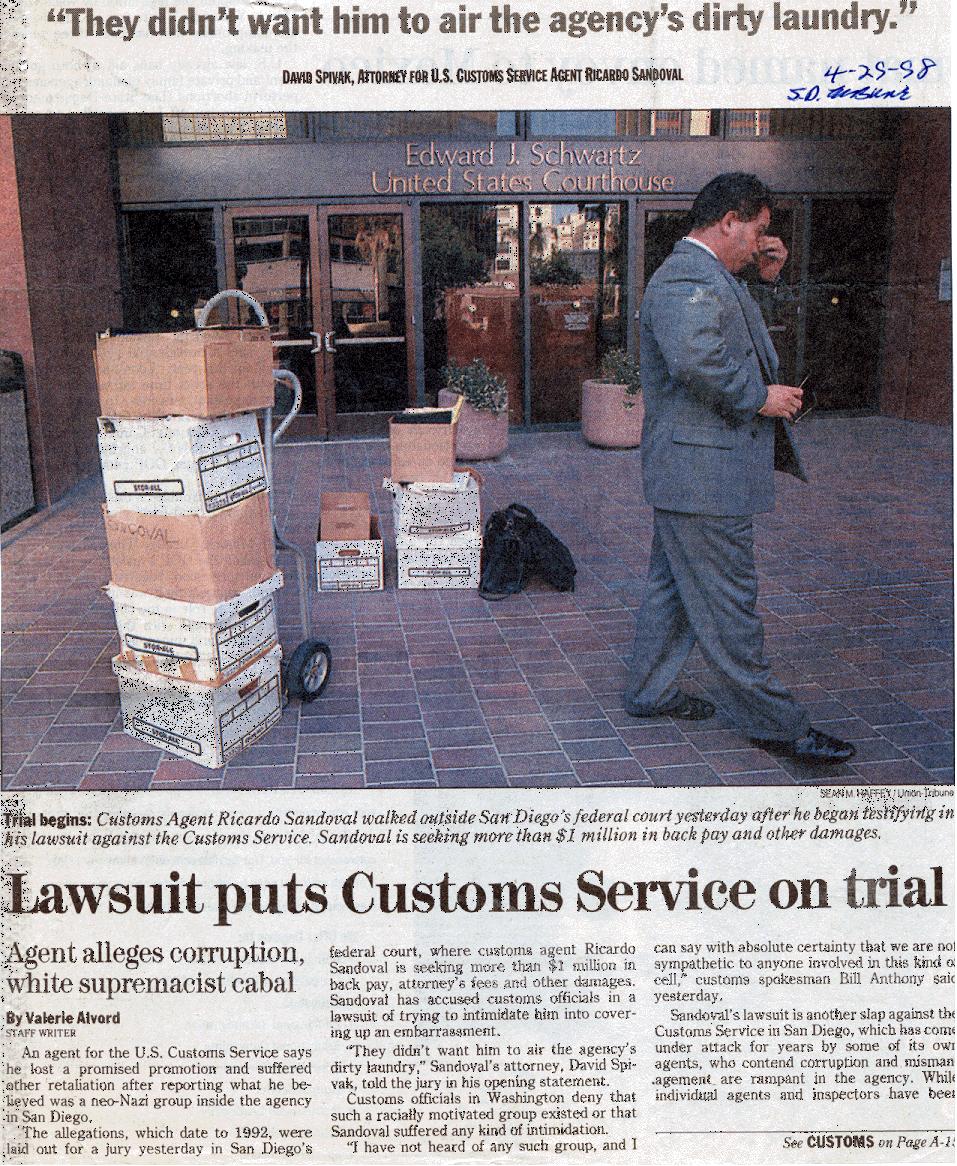 Lawsuit Puts Customs Service on Trial Part 1
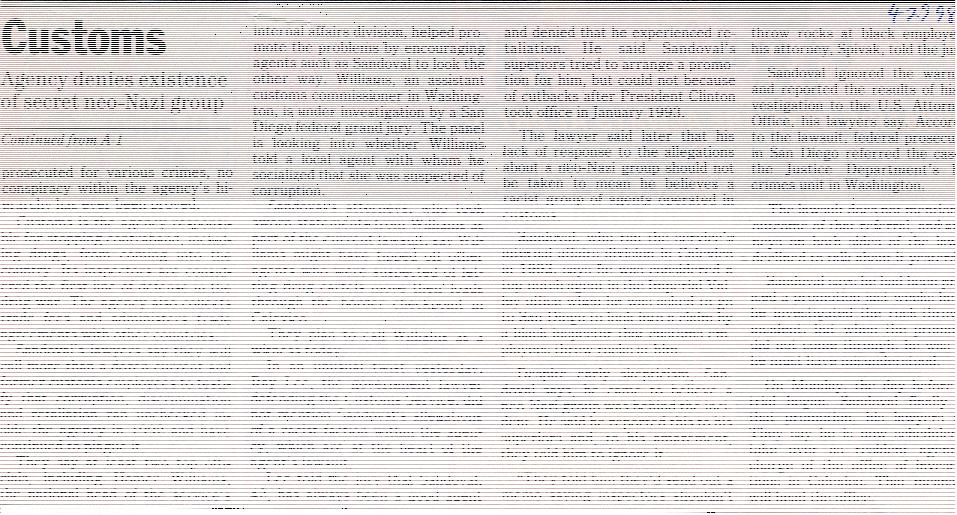 Lawsuit Puts Customs Service on Trial Part 2